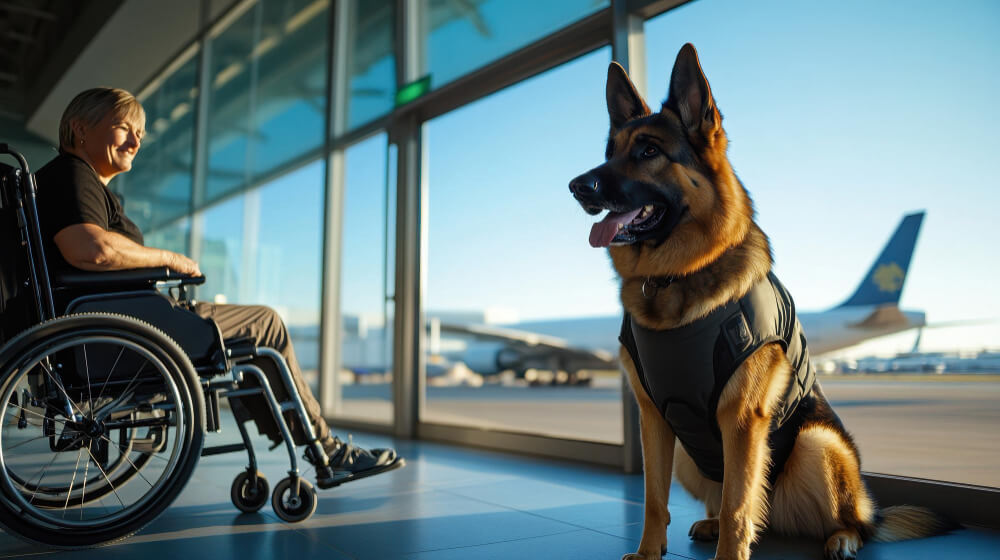
What Actually Changes When You Travel With an Assistance Dog
If you are preparing to fly through a London airport with an assistance dog for the first time, the question that sits at the back of most passengers' minds is not whether they are allowed to travel. The Equality Act 2010 makes the right to do so clear. The real question is what the journey will actually look like, stage by stage, and whether anything will catch you off guard. Most of the support is there. Most of the infrastructure works well. The gaps tend to appear when passengers have not been told what to prepare before they leave home.
Travelling with an assistance dog adds a layer of coordination to every stage of the airport process: pre-travel documentation, check-in, security, boarding, and arrival. Each step is manageable. None of them are complicated once you understand what is expected. This guide covers what changes at each stage, how to prepare, and what to notify in advance so that the process works as smoothly as it should.
The support available at London airports for assistance dog passengers is comprehensive. What makes the difference is early notification. Most complications arise when passengers have not informed their airline and airport in advance.
What Qualifies
What Counts as an Assistance Dog in the UK
The term matters at the airport. UK airlines and airports distinguish clearly between trained assistance dogs, emotional support animals, and pets. Only trained assistance dogs are permitted to travel in the aircraft cabin. Emotional support animals are not recognised under UK aviation rules and must travel as pets, which means they go in the hold under separate arrangements.
Under the Equality Act 2010, an assistance dog is a dog trained to assist a disabled person with a specific disability-related task. In practice, the dogs airlines and airports consistently recognise are those trained by organisations accredited by Assistance Dogs UK (ADUK), Assistance Dogs International (ADI), or the International Guide Dog Federation (IGDF). ADUK member organisations currently include Guide Dogs, Hearing Dogs for Deaf People, Canine Partners, Medical Detection Dogs, Support Dogs, and Dog A.I.D. Airlines may ask for evidence of training by a recognised organisation. The ID booklet issued by charity-trained programmes is not a legal requirement under UK law, but it is the most straightforward form of evidence to carry. Owner-trained assistance dogs are recognised in UK guidance; however, airlines may request documentary evidence of training, so it is worth contacting your airline to confirm what they accept before travel.
"Only fully trained assistance dogs that perform specific tasks to support a person with a disability qualify under UK and international aviation rules."UK Civil Aviation Authority Guidance on Assistance Dogs
One distinction worth understanding before departure: the rules that apply to flying out of a UK airport differ from the rules that apply to arriving back into the UK from abroad. The incoming journey involves the UK Pet Travel Scheme, documentation requirements, and in some cases pre-approval from the relevant Animal Reception Centre. Both directions are covered in this guide.
Before You Travel
The Pre-Travel Steps That Determine How the Day Goes
Most of what happens smoothly on the day of travel was arranged in the days or weeks before. There are four categories of pre-travel action: notifying your airline, booking airport assistance, confirming documentation, and, for international travel, contacting the relevant Animal Reception Centre. Each has a deadline. Missing any of them does not necessarily prevent travel, but it introduces delays and uncertainty that are straightforward to avoid.
Notify Your Airline
Inform your airline that you are travelling with an assistance dog at least 48 hours before departure. Most airlines recommend doing this at the time of booking. The airline will confirm acceptance, allocate appropriate seating, and pass your details to the airport's assisted travel team. Contact the airline directly even if you booked through a third party.
Book Airport Assistance
Request Persons with Reduced Mobility (PRM) assistance through your airline or directly with the airport. This service assigns a dedicated assistance team member who will meet you at an agreed point, escort you through check-in, security, and to the gate, and ensure access to the dog spend area before boarding. Book at least 48 hours in advance for priority allocation.
Confirm Documentation
For domestic flights, carry your dog's ID booklet or other training documentation. For international departures, confirm the destination country's entry requirements for assistance dogs well in advance, as they vary significantly. For international arrivals into the UK, contact the relevant Animal Reception Centre at your arrival airport at least 72 hours before your flight to seek pre-approval.
For passengers arriving at Heathrow from outside the UK, pre-approval from the Heathrow Animal Reception Centre is mandatory and must be obtained at least 72 hours in advance. Travelling without it can result in quarantine or re-export at the passenger's cost. The equivalent requirement at Gatwick is handled by Animal Aircare, which carries out Pet Travel Scheme checks on board the aircraft, provided the airline has pre-notified them. Luton Airport requests that passengers email their flight details and documentation photographs to specialassistance@ltn.aero in advance of arrival. London City Airport asks simply that the airline is notified at least 48 hours before travel.
Airport by Airport
Assistance Dog Facilities at London's Five Major Airports
Every London airport offers assisted travel services for passengers travelling with assistance dogs. The facilities differ in scale and layout. Understanding what each airport provides, and where to find it, removes one variable from an already complex day.
| Airport | Spend Area | Assistance Areas | On-Aircraft Checks (Arrivals) | Pre-Approval Required | Key Contact |
|---|---|---|---|---|---|
LHR Heathrow |
✓ Hard & soft surfaces | T2 Level 1 / T3 Zone B / T5 Level 5 (pre-security) | ✓ | ✓ 72hrs min (international) | Heathrow Animal Reception Centre |
LGW Gatwick |
✓ Post-security access available | Assisted Travel desks, both terminals | ✓ Via Animal Aircare | Airline must pre-notify | Gatwick Assisted Travel / Animal Aircare |
STN Stansted |
✓ Pre-security spend area | Assisted Travel desk, main terminal | ✓ On disembarkation | Airline notification required | Stansted Assisted Travel team |
LTN Luton |
✓ Front of terminal building, near bus stop T | Assisted Travel team via airline pre-booking | Confirm with airline | Email documentation in advance | specialassistance@ltn.aero |
LCY London City |
Confirm on booking | Compact terminal; assistance team on request | Confirm with airline | ✗ Not required for LCY arrivals | Airline notification at least 48hrs |
At Stansted, if a passenger arrives from abroad, the assisted travel team requests that all other passengers disembark first before escorting the handler and dog off the aircraft. Documentation checks are completed on board. At Heathrow, a member of the assistance team meets passengers at the aircraft on international arrivals. These on-aircraft checks are designed specifically so the dog remains with its handler at all times.
Through the Airport
What Happens at Check-In, Security, and Boarding
The airport journey with an assistance dog follows a similar sequence to a standard departure, with three specific differences: a spend area visit before security, a modified security screening process, and priority boarding. Knowing the sequence in advance means there are no surprises on the day.
At check-in, staff will confirm that your airline has a record of your assistance dog and verify documentation. If you have booked PRM assistance, an escort will meet you at the point you agreed during booking. That point can be the terminal entrance, a car park, a taxi drop-off, or the check-in desk itself. Carry your dog's ID booklet, harness, and any documentation relevant to your destination. For international travel, the check-in agent may run through a checklist to confirm you have the correct paperwork for the dog to leave and re-enter the country.
Your PRM escort should offer to take you to the dog spend area before proceeding to security. This is one of the most practically important steps of the whole journey. Dog spend areas are located before security at most London airports, and again airside at some. Confirm access to both when you book assistance.
Security is the stage that concerns most first-time handlers. The process is well-established and airport staff are trained for it, but it is worth knowing the steps precisely. When you reach the security lane, you will place personal belongings in screening trays as normal. The dog's harness does not need to be removed at this stage. You will pass through the body scanner independently. An officer will hold the dog's lead briefly while you complete the scan. The dog is not placed in the scanner.
Once your scan is complete, you will be seated while the dog's harness is searched and swabbed for explosive residue. This is a standard step, not a cause for concern. At Stansted, the process is clearly defined: harness search and swab, then the handler collects all belongings and continues airside. If you would prefer privacy during the harness search, a private screening room is available at most airports. Request it in advance or ask when you arrive at the security lane. The dog is never separated from its handler at any point during the process.
Passengers travelling with assistance dogs board before the general passenger group. This is standard practice across UK airlines and allows time to settle into the correct seating position without the pressure of boarding queues forming behind you. Your seating will have been confirmed in advance. Airlines typically allocate bulkhead rows, which provide more floor space at your feet for the dog to lie down during the flight. The dog must remain in the footwell throughout the flight and must not obstruct aisles or emergency exit routes.
Most airlines require the dog to be secured to the seat belt, either via a harness connector or an extension belt, during take-off, landing, and whenever the seat belt signs are illuminated. Carry an absorbent mat or fleece for the dog to lie on, particularly on longer flights. Cabin crew will not be able to assist with the dog during the flight; all care is the handler's responsibility. For flights over three hours, plan for water. Liquids are restricted through security, but water can be purchased airside or requested on the aircraft.
On arrival into the UK from an international destination, the assistance team will meet you at the aircraft. At airports such as Heathrow and Gatwick, Pet Travel Scheme checks are conducted on board so the dog does not need to be separated from you at any point. At Heathrow, an animal health officer meets the aircraft to complete entry checks. At Gatwick, Animal Aircare staff board the aircraft for the same purpose, provided the airline has pre-notified them. After clearance, you proceed through passport control and into arrivals with your dog.
For domestic flights, the arrival process is straightforward. There are no Pet Travel Scheme requirements for flights within the UK. Your escort will assist you through immigration and on to baggage reclaim and into the arrivals hall if required.
Fixed-price, door-to-door transfers to all London airports, with meet and greet and flight tracking included as standard.
Book Your TransferGetting to the Airport
The Journey to the Airport: Why the First Step Matters
The airport process is well supported. The journey to get there is often where passengers travelling with assistance dogs encounter the most uncertainty. Public transport, crowded carriages, narrow spaces, and unpredictable services are not designed around a handler and a working dog. The stress accumulated before reaching the terminal affects both the passenger and the dog.
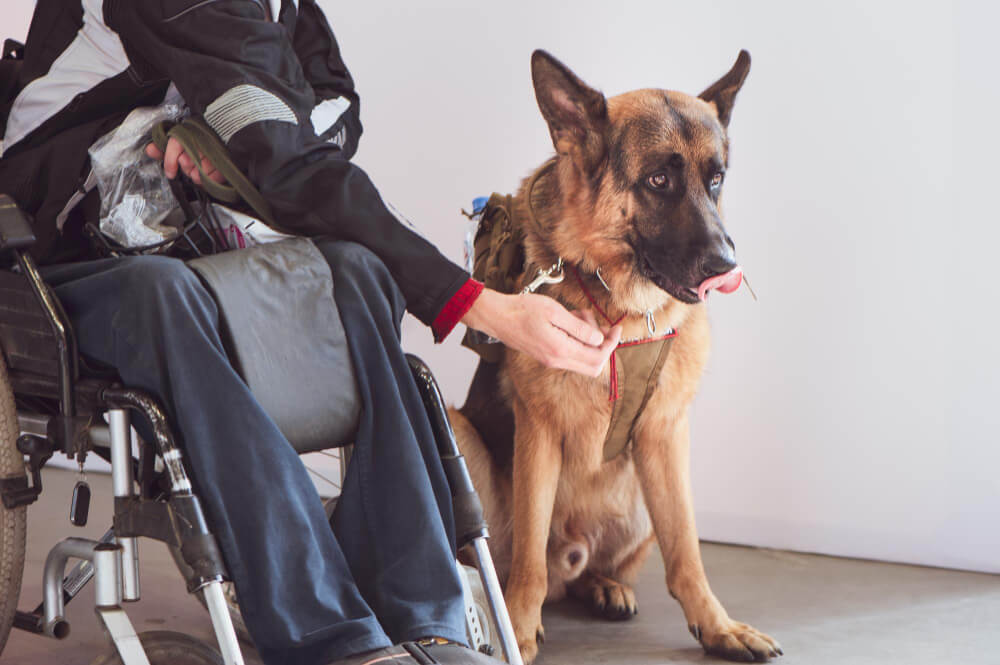
A pre-booked private transfer solves the specific problems that public transport creates for assistance dog passengers. There is no negotiation over space in a carriage. There are no other passengers. The vehicle goes directly from the passenger's door to the terminal, which means no connections, no steps, and no uncertainty about the route. For passengers who have coordinated every stage of the airport journey with care, it makes sense to apply the same care to getting there.
Umbrella Transfers provides fixed-price airport transfers to all five of London's major airports, including Heathrow, Gatwick, Stansted, Luton, and London City, with meet and greet and flight tracking included as standard. Vehicles are private and door-to-door, which means there is space for the passenger, the dog, and luggage without compromise. The driver monitors flight times and adjusts pickup accordingly, so a delay does not leave a passenger and their dog waiting at a kerb. 24/7 real-person support is available for any changes to the journey. For a passenger who has an already complex travel day ahead of them, removing the ground-transport variable is a straightforward decision.
The single most reliable signal that a journey will go smoothly is early notification. Every stage of the airport process, from the PRM escort to the on-aircraft Pet Travel Scheme check, is triggered by the action of telling the airline in advance.
Practical Guidance
Domestic vs International: Where the Requirements Differ
The airport experience for assistance dog passengers divides into two distinct categories. Domestic travel within the UK is straightforward by comparison. International travel introduces documentation requirements, veterinary timelines, and country-specific rules that need to be understood well before the departure date.
Domestic Flights Within the UK
Notify the airline at least 48 hours before travel and request PRM assistance. No Pet Travel Scheme documentation is required. The process follows the same stages described in this guide: check-in, spend area, security, priority boarding, and arrival without additional checks. This is the least administratively complex scenario for assistance dog passengers.
International Departures from the UK
Destination country requirements vary enormously. EU travel requires an Animal Health Certificate (AHC), valid for one trip and issued by a government-authorised vet. The USA requires a completed CDC Dog Import Form. Australia requires quarantine clearance that can take several months to arrange. Check the specific requirements for your destination at least eight weeks before travel and verify them again closer to departure, as regulations change.
International Arrivals into the UK
Dogs arriving from abroad must meet UK Pet Travel Scheme requirements: microchipping, rabies vaccination, and in some cases tapeworm treatment. For Heathrow, pre-approval from the Animal Reception Centre is required at least 72 hours before the flight. For Gatwick, the airline must pre-notify Animal Aircare. An animal health officer will conduct checks at the aircraft on arrival so the dog does not leave your side.
First-Time Flyers With an Assistance Dog
Allow considerably more time on your first journey. Arrive at the airport earlier than the standard recommendation, so that the spend area visit, check-in, and security do not become rushed. Contact the assisted travel team at your specific airport before the trip to walk through the process in advance. Most airports are willing to answer detailed questions ahead of travel.
Final Thoughts
A Prepared Journey Is a Smooth Journey
Travelling through a London airport with an assistance dog is well supported. The infrastructure exists. The legislation is clear. The assisted travel teams are trained. What the airport cannot do for you is notify your airline, arrange the pre-approval, and prepare the documentation. Those steps belong to the weeks before travel, not the morning of departure.
The passengers who find the airport process straightforward are almost always the ones who made the calls early, confirmed the details in writing, and arrived knowing exactly what to expect at each stage. The process itself is not difficult. It is predictable. And a predictable journey is a calm one, for the handler and for the dog.
For any assistance dog passenger travelling through a London airport, the advice is consistent across every source: early notification is everything. Book assistance. Confirm the spend areas. Carry the documentation. Arrange a private transfer to the terminal so the day starts on the right footing. Everything after that is manageable.
Notify your airline at least 48 hours before travel. Book PRM assistance at the same time. For international arrivals into the UK, contact the relevant Animal Reception Centre at least 72 hours before your flight. Carry training documentation. Arrive earlier than you would for a standard journey. Arrange door-to-door transport so the airport process begins, not ends, at the terminal.
Fixed-price airport transfers
Travel to the airport without the uncertainty
Door-to-door transfers to all London airports. Meet and greet, flight tracking, and 24/7 support included as standard. Private vehicles with space for passengers, dogs, and luggage.
Book Your Transfer