
London Is a Working Capital, and the Road Reflects That
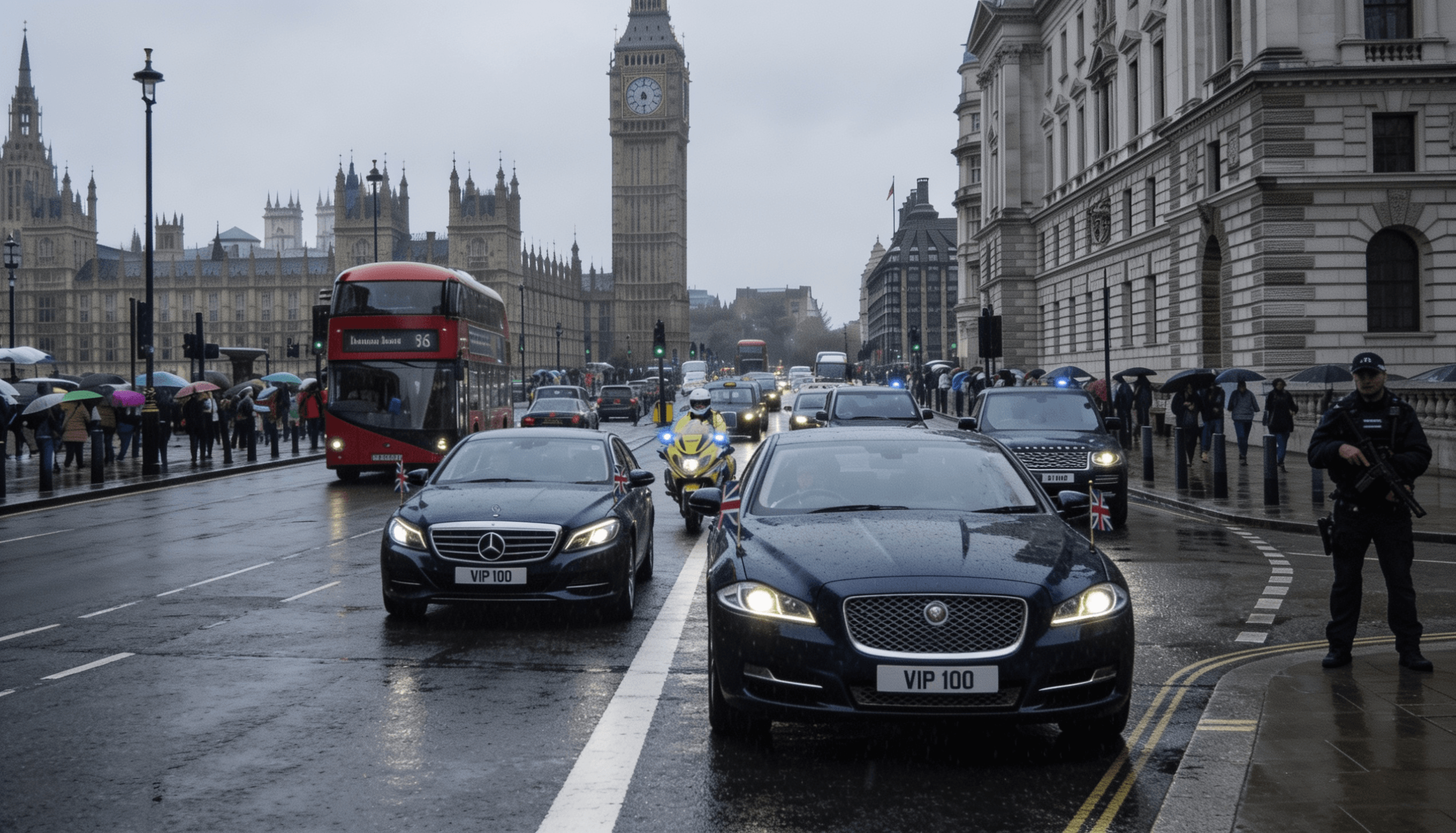
The car has stopped. There are motorcycle outriders ahead with blue lights. Vehicles in all lanes are holding position and nobody seems to be moving. If that moment has ever caught you off guard mid-journey, you are not alone. What is actually happening is one of the most organised and precisely rehearsed traffic operations in any city on earth. It is a diplomatic convoy, or possibly a royal movement. It will be over before most passengers have decided what to think about it.
London hosts 168 resident embassies and high commissions, making it one of the densest diplomatic communities in the world. The United Kingdom also receives between two and four formal state visits per year, hosted by the King, each accompanied by carriage processions and vehicle motorcades through the heart of the city. Add the movement of government ministers, senior visiting officials, and the day-to-day operations of the Metropolitan Police's Protection Command, and the picture becomes clear: motorcades are not rare events in London. They are part of the city's working rhythm, as routine as a signal failure on the District line or a roadworks closure on the A4.
A diplomatic motorcade is not a random event. It is a precision operation with defined routes, trained personnel, and a clear objective: keep the convoy moving, keep disruption to a minimum, and restore traffic flow within minutes of the convoy passing.
Who Runs Motorcades in London
The Metropolitan Police Units Behind Every Motorcade
Two specialist branches of the Metropolitan Police's Protection Command are responsible for the vast majority of diplomatic and royal movements through London's streets. Understanding what each one does makes the scene in front of you considerably less puzzling.
The Special Escort Group (SEG), formed in 1952, is the mobile arm of the Royalty and Specialist Protection (RaSP) division. Its officers provide armed motorcycle escorts for members of the Royal Family, the Prime Minister, visiting heads of state, and other protected dignitaries. For a routine royal movement, the SEG deploys around three motorcycle outriders. For a full state visit with a visiting head of state, that number can rise to twelve. SEG riders use Honda VFR 1200 motorcycles in plain white livery with blue lights. They carry no sirens. Instead they use whistles, a deliberate choice: whistles cut through urban noise more precisely and avoid the desensitisation that years of sirens have produced in urban drivers.
The Parliamentary and Diplomatic Protection (PaDP) command, formed in 2015 through a merger of the Diplomatic Protection Group and the Palace of Westminster Division, covers static protection of embassies, Downing Street, Parliament, and the residences of senior figures. PaDP vehicles are identifiable by their distinctive red livery, unlike standard Metropolitan Police blue. Both branches operate under the Met's Specialist Operations directorate, and both are authorised firearms commands.
"The goal of the SEG outriders is to enable the VIP convoy to keep moving while causing minimal disruption to the public."Metropolitan Police, on SEG operational doctrine
That principle is worth holding onto. The convoy does not stop. The surrounding traffic does, briefly, to allow the convoy through. Movement is restored the moment the rear vehicle clears the junction.
How to Read a Motorcade
What You Are Actually Seeing When Traffic Stops
Most of the confusion around motorcades comes from not recognising the individual components as they appear. Once those components are familiar, a motorcade is entirely legible. Here is what each element signals and what it tells a driver about the likely duration of the hold.
Outriders Blocking Junctions
The first thing most drivers see is a motorcycle officer pulling across a junction to hold cross-traffic. This is a "working bike" from the SEG, clearing the route ahead. The convoy is typically two to three minutes behind. The outrider will release the junction the moment the convoy's rear vehicle clears.
The Lead Car and the Easy Rider
Immediately ahead of the principal vehicle, one SEG motorcycle maintains a fixed position at all times. This is the Easy Rider, controlling pace and position for the entire convoy. Behind it, the principal vehicle or vehicles, typically armoured Range Rovers or equivalent, travel at a steady 20 to 25 mph through central London streets.
Diplomatic Number Plates
Vehicles within the convoy, or travelling separately under diplomatic protection, carry plates in the format 123 D 456 or 123 X 456. The letter D indicates a fully accredited diplomat under the Vienna Convention on Diplomatic Relations (1961). The letter X indicates non-diplomatic accredited staff. These plates have been issued by the DVLA and Foreign, Commonwealth and Development Office since 1979.
State Visit Carriage Processions
During formal state visits, the visiting head of state and the King travel by horse-drawn carriage along The Mall, through Horse Guards Parade, and towards Buckingham Palace. On these occasions the traffic lights along The Mall are physically removed from the ground to allow processions to use the full road width. These events are announced publicly and are not unforeseeable.
Red-Liveried PaDP Vehicles
A vehicle with a broad red stripe and Metropolitan Police markings belongs to Parliamentary and Diplomatic Protection. These are most frequently seen outside embassies, at Downing Street, and around the Palace of Westminster. Their presence on a moving route usually signals the escort of a senior government minister or a visiting dignitary whose protection sits with PaDP rather than SEG.
The Rear Guard and Traffic Release
The final vehicle in any convoy carries the rear guard. Once it passes a junction, the outrider holding that junction releases and moves forward to the next position. This is the moment traffic flows again. The total disruption at any single junction is usually measured in under two minutes for a standard convoy.
Where Motorcades Happen
London's Diplomatic Corridors and Why They Matter for Your Journey
Motorcades do not move randomly through London. They follow pre-planned routes assessed for security, access, and the ability to control junctions efficiently. Certain corridors carry the vast majority of diplomatic and royal traffic, and a professional driver operating in London will be familiar with all of them.
| Corridor | Primary Use | Key Origin or Destination | Disruption Profile |
|---|---|---|---|
| The Mall | State visit carriage processions, royal movements | Buckingham Palace to Horse Guards Parade | Fully closed during state visits; lights removed from ground |
| Whitehall | Government and diplomatic convoys | Downing Street, Horse Guards, Parliament | Frequent partial holds; highest concentration of diplomatic movement |
| Park Lane / A40 approach | Airport arrivals for heads of state | Heathrow to central London via M4 | Outrider-controlled corridor for state arrivals; most visible during state visits |
| Outer Circle, Regent's Park | US Presidential and ambassador convoys | Winfield House (US Ambassador's residence in Regent's Park) | Sporadic; most intense during US presidential state visits |
| Kensington and Belgravia | Embassy-to-embassy and residence movement | High concentration of embassies in these districts | Lower-profile, smaller convoys; less likely to hold cross-traffic |
| Constitution Hill | Royal movements to and from Buckingham Palace | Buckingham Palace gate to Hyde Park Corner | Short holds; SEG outriders with one to three motorcycles |
Winfield House, the official residence of the United States Ambassador set within 12 acres of Regent's Park, is the origin point for American presidential motorcades in London. During US state visits, the route from Regent's Park to Downing Street and the Palace of Westminster generates the most visible and widely reported convoy activity of any single diplomatic event in the city.
What Actually Happens to Your Journey
How a Motorcade Affects Your Transfer, and What a Professional Driver Does
The question passengers most want answered in the moment is simple: how long will this take? The honest answer depends on where in the convoy's route your vehicle happens to be sitting. A junction hold while an outrider clears the way typically lasts under two minutes at any single point. Being stopped multiple times on a longer route, for example between Heathrow and central London during a presidential state arrival, may add ten to fifteen minutes in total across the full journey. That is meaningful on a tight schedule. It is not a crisis. The difference between those two outcomes is largely determined by how prepared the driver was before the situation arose.
Professional London chauffeurs and private hire drivers working in the central zones develop familiarity with the operational patterns that predict diplomatic activity. State visits are announced publicly by the Royal Household well in advance. The diplomatic calendar is not secret. A driver who monitors live traffic conditions and is aware of scheduled ceremonial events can often route around the primary corridor before a hold occurs, rather than sitting in it. This is not a guarantee, and some convoys are not publicised in advance, but awareness significantly narrows the window of genuine surprise.
When a hold is unavoidable, the correct response is also the calm one. The vehicle stops. The convoy passes. The outrider releases the junction. Traffic resumes. Attempting to manoeuvre aggressively around junction holds, or to follow closely behind a convoy's rear vehicle, is both unsafe and likely to draw the attention of the protection officers who monitor precisely that kind of behaviour. The convoy moves at 20 to 25 mph through central London. It is not worth chasing.
A driver who checks the ceremonial events calendar, monitors live traffic on the day, and builds contingency time into routes near Whitehall and The Mall on days when a state visit is scheduled will rarely be caught in an unavoidable hold. The disruption profile of a London motorcade is predictable for those who look for the signals.
When a junction hold occurs without advance notice, a professional driver reads the signals: white-liveried SEG motorcycles with blue lights, red-striped PaDP vehicles, or police officers on foot holding cross-traffic. Each of these identifies a diplomatic or royal movement rather than a standard traffic incident or road closure, and tells an experienced driver approximately how long the hold is likely to last.
A driver who can name what is happening, explain the mechanism, and give a realistic time estimate transforms the moment from an anxiety-inducing unknown into an interesting footnote. Most passengers, once informed, find a diplomatic convoy a notable rather than frustrating experience. The difference is entirely in the communication.
Fixed-price London airport transfers with professional drivers who know the city's diplomatic corridors.
Book Your TransferChoosing Your Transfer Service
What to Confirm and What to Avoid When Booking a London Transfer
For travellers arriving at one of London's airports and heading into central London, the question of motorcade awareness is really a subset of a broader one: how prepared is your driver for the full range of conditions on a London road? Choosing a service that operates with genuine city knowledge is more relevant on a day when Whitehall is under escort than on any other. Here is how to assess that before you travel.
The most reliable signal of a genuinely prepared London transfer is not vehicle quality or star rating. It is whether the driver's knowledge of the city extends to conditions that are not in a sat-nav: ceremonial closures, diplomatic corridors, and the kind of holds that a traffic app will not flag until they are already happening.
Practical Guidance by Journey Type
How Motorcade Awareness Changes Depending on Your Journey
Not every transfer route carries the same exposure to diplomatic traffic. The practical relevance of this guidance shifts considerably depending on where you are going, when you are travelling, and what kind of schedule you are working to.
Airport arrivals heading into central London
The A4 and M4 corridor from Heathrow into central London is the primary route used by motorcades transporting state visitors from the airport. During formal state visits, this corridor may carry multiple convoy movements across the visit's first day. A pre-booked transfer with a driver who has monitored the day's diplomatic calendar provides meaningfully better protection against surprise holds than an on-demand service dispatched reactively.
Business travellers on tight schedules
For business travel into Westminster, Whitehall, or the City, the possibility of a motorcade hold on the final approach is worth building into your departure time rather than discovering on the day. Ten minutes of contingency time costs nothing. Missing a meeting because a convoy cleared thirty seconds after your arrival window closed costs considerably more.
Travellers routing through Kensington or Belgravia
Both Kensington and Belgravia carry a very high concentration of embassies and high commissions. Convoy activity in these districts tends to be lower-profile than a full state visit motorcade, but it is more frequent. Transfers to or from London City Airport routing through these areas may encounter smaller protective escorts with less advance warning.
Passengers travelling from Gatwick or Stansted
Transfers from Gatwick and Stansted typically route into central London on corridors further from the primary diplomatic zones. The risk of a motorcade hold is lower, but the same principle applies: a driver who knows where the concentrations are can route to avoid them when conditions allow, rather than driving through them by default.
For passengers travelling with chauffeur services in London, the value of an experienced professional driver is greatest precisely in unscripted moments: the motorcade hold, the unexpected closure, the diversion. Knowledge of the city's diplomatic corridors is part of what separates a professional service from a car and a sat-nav.
Final Thoughts
London Works on Multiple Timetables at Once
The city that hosts 168 embassies, receives heads of state several times a year, and runs the world's most recognisable ceremonial military operations does not apologise for its complexity. Nor should it. A diplomatic motorcade is not an inconvenience inserted into a normal day. It is evidence that London is doing what world capitals do: moving the business of international relations through its streets, as it has for decades.
The distinction that matters for anyone travelling through this city is whether the people responsible for their ground transport treat that complexity as a known condition or an unwelcome surprise. For a passenger in the back of a London airport transfer, the motorcade is a two-minute pause and a story to tell at the other end. The driver's awareness of the city, its diplomatic corridors, and its ceremonial calendar is what determines whether it stays that way. Umbrella Transfers operates fixed-price services across all five London commercial airports with drivers who work these routes daily, monitoring live conditions and building the kind of city knowledge that does not come from a mapping application.
Book a fixed-price service so a hold never becomes a higher fare. Choose a provider with real flight monitoring and free waiting time from actual landing. Give yourself ten minutes of contingency on routes near Whitehall or The Mall on state visit days. And when the blue lights appear ahead, stay calm. The convoy will clear, and the road will open. It always does.
Fixed-price London airport transfers
Arrive in London without the guesswork
Meet and greet as standard. Flight tracking and free waiting time from actual landing. Professional drivers who know the city's roads, conditions, and corridors.
Book Your Transfer