
London Design Festival 2026: What You Are Arriving Into
If you have tried to plan a London Design Festival day and found yourself staring at a programme of 400-plus events scattered across a city of nine million people, you are not alone. The festival is genuinely vast. For its 24th edition, running 12 to 20 September 2026, eleven design districts activate simultaneously across London, from the riverside industrial heritage of Bankside in the south-east to the craft-focused Blackhorse Creates in Walthamstow to the north-east. Soho joins as a brand-new district this year. Shoreditch Design Week replaces the former Shoreditch Design Triangle, bringing over 60 showrooms, galleries and creative spaces into a more ambitious, formally structured programme running from 15 September. The problem is not a shortage of things to see. It is working out, on a map, which things are physically close to each other and which ones will cost you an hour of travel for a twenty-minute visit.
The V&A in South Kensington serves as the festival's central hub, hosting the Global Design Forum from 12 to 14 September alongside major commissions and landmark installations. The Design Museum adds its own substantial programme nearby. Beyond these anchors, the eleven districts function as semi-autonomous clusters, each with its own character, its own opening days, and its own density of events. Understanding that structure before you arrive is what separates a productive week from an exhausting one.
London Design Festival is not one event in one place. It is eleven distinct creative clusters spread across a city where the distance between the westernmost and easternmost districts exceeds 15 miles. The visitors who see the most are the ones who plan geographically, not alphabetically.
The Real Problem
Why Most Festival Visitors See Less Than They Should
The standard approach to London Design Festival planning is to browse the programme, bookmark the sessions that look compelling, and assume the logistics will sort themselves out on the day. They rarely do. The official programme map shows venues as dots. It does not show that some of those dots are a forty-five-minute Tube journey apart with two changes, or that the EC1 district and the Bankside district are separated by a river crossing and a fifteen-minute walk that feels considerably longer when it is raining in September. Visitors who plan by interest rather than by geography routinely find themselves spending more time in transit than in showrooms.
There is a second, less obvious problem. Many of the most significant events are time-specific. Shoreditch Design Week's four headline venues run their primary programming on 15, 16, and 17 September. The Global Design Forum at the V&A runs 12 to 14 September only. Attending both in a single visit requires not just geographic planning but calendar sequencing. Arriving in London with a list of venues but no spatial framework for connecting them is the most reliable way to underuse nine days of programming.
"The festival belongs to those who plan it like a route, not a wishlist."Umbrella Transfers Editorial
What follows is that spatial framework: the districts grouped by geography, the day routes that make logical sense on the ground, and the transport decisions that protect your time between them.
District by District
The Eleven Districts and What Each One Actually Offers
Understanding the character of each district before you arrive means you can match your priorities to the right cluster rather than navigating by name alone. The eleven 2026 districts divide naturally by geography and by the type of visitor they serve best.
Brompton Design District
The festival's most established western cluster, stretching from the V&A along Brompton Road. Global showrooms, curated exhibitions, and a density of international collections that rewards an unhurried morning. Best suited to those sourcing high-end interiors and furniture.
Shoreditch Design Week
The festival's largest dedicated district for 2026. More than 60 venues across the former London furniture trade territory. Best navigated on foot or by bicycle. Primary venues run 15 to 17 September; the wider district stays active to 20 September.
EC1 Design District
Centred around Farringdon and the Barbican. An impressive concentration of architecture practices, specification-led showrooms, and design studios. The professional's district, with a programme oriented towards architects, specifiers, and material sourcing.
Bankside Design District
Runs along the Thames from Borough Yards to Coin Street. Industrial riverside character, home to Tate Modern, Shakespeare's Globe, and Borough Market. Rich in craft, typography, and material innovation, with Oxo Tower Wharf adding open studios.
Mayfair Design District
Luxury showrooms, galleries, and brand activations in London's most architecturally formal neighbourhood. Now the festival's third-largest district, spanning art, design, fashion, and hospitality with an elevated register throughout.
Soho Design District
New for 2026. Placing Soho's long-standing creative ecosystem at the centre of the festival for the first time. Architects, F&D specialists, branding agencies, and property innovators. A culturally significant addition rooted in Soho's identity as a driver of London creativity.
Chelsea Design District
Centred on the King's Road and Fulham Road corridor. Design, fashion, homeware, food, wellness, and botanic brands. Broad appeal beyond the trade audience, suited to lifestyle visitors and professionals alike.
Fleet Street Quarter
A compact district in the historic press corridor between the City and the Strand. Strong on architecture and print culture. Manageable in a single afternoon and well positioned as a bridge between EC1 and the West End.
Dalston to Stokey
Hackney's design community opens its studios and workshops. Craft, sustainability, and local production at the centre of the programme. A district for those interested in the making process rather than finished product launches.
Park Royal Design District
West London's industrial creative zone. Studio visits to spaces typically closed to the public. Specialist for those interested in manufacturing, material innovation, and the working infrastructure behind design production.
Blackhorse Creates
Formerly the William Morris Design Line, rebranded for 2026. Based around Blackhorse Lane in Walthamstow, a Creative Enterprise Zone since 2021. Community-led making, craft studios, and over 400 local businesses with deep roots in design and manufacture.
Geographic Clusters
Which Districts Belong Together on the Same Day
Grouping the eleven districts by geography rather than by name is the first practical step in any festival plan. Four natural clusters emerge when you look at the map. Staying within a cluster for a full day is the single most effective way to increase the number of venues you can reach without burning time in transit.
| Cluster | Districts | Anchor Transport Hub | Best for | Within-cluster travel |
|---|---|---|---|---|
W West |
Brompton, Chelsea, Mayfair, Soho | South Kensington, Green Park, Oxford Circus | Showroom sourcing, luxury collections, V&A programme | Walkable or short taxi between districts |
C City and Riverside |
EC1, Fleet Street Quarter, Bankside | Farringdon, Blackfriars, London Bridge | Architecture, specification, craft, material innovation | Walkable once south of the river |
E East |
Shoreditch Design Week, Dalston to Stokey | Old Street, Liverpool Street, Dalston Junction | Product launches, emerging designers, studio culture | Walkable or bicycle within Shoreditch |
O Outer |
Park Royal, Blackhorse Creates | Park Royal (Piccadilly line), Blackhorse Road (Victoria line) | Manufacturing visits, craft trails, specialist studios | Plan as dedicated half-days |
Crossing from one cluster to another costs time that cannot be recovered in the day. Brompton to Shoreditch by public transport takes 40 to 50 minutes with at least one change. By a pre-booked private chauffeur transfer, the same journey takes around 25 minutes door to door, with no luggage management and no platform waiting. For a full day in London, that difference is one additional showroom or one additional session at the Global Design Forum.
Route Planning
Three Day Routes That Work on the Ground
The following routes are designed to minimise transit time while maximising the density of venues accessible within a single day. Each operates within or adjacent to a natural geographic cluster. None requires crossing the full city. All three are viable for individual visitors and for corporate groups attending the festival for business travel purposes.
Route One: The West London Design Day
Begin at the V&A in South Kensington, which opens at 10:00. The Global Design Forum runs here from 12 to 14 September; outside those dates, the V&A's main festival commissions are accessible throughout all nine days. Walk north along Exhibition Road and cut through to Brompton Road: the Brompton Design District's showroom corridor begins immediately. Allow two to three hours for Brompton, where international brands and curated installations sit within a compact, walkable strip. From Brompton, a twelve-minute taxi or a twenty-minute walk through Belgravia takes you to the Mayfair Design District. Soho, new to the festival in 2026, is a ten-minute taxi north of Mayfair. Its programme brings together architects, branding agencies, and property innovators across a district that has long shaped London's creative identity but never before featured formally in the festival.
Route Two: The City and Riverside Circuit
Start in EC1 at Farringdon, the festival's most professionally focused district. Architecture practices, specification showrooms, and material-oriented studios make it the right starting point for those sourcing rather than browsing. Walk south-east through Clerkenwell towards Fleet Street Quarter, which is compact and best used as a thirty-minute interlude between EC1 and the river. Cross Blackfriars Bridge on foot and you are in Bankside Design District territory: Borough Yards, the Oxo Tower Wharf open studios, and the riverside installations running west towards Coin Street. Allow a full afternoon for Bankside. It rewards slow movement.
Route Three: The East London Day
Arrive at Shoreditch Design Week via Old Street or Liverpool Street station. The district's headline venues run their primary programming on 15, 16, and 17 September: arrive on one of those three days to access the full Shoreditch programme. More than 60 venues across the neighbourhood mean a single day will not cover everything; prepare a shortlist from the official programme map in advance and move systematically. From the northern edge of Shoreditch, Dalston Junction is fifteen minutes by bus or London Overground to Dalston to Stokey, where craft studios and sustainability-focused open studios provide a quieter counterpoint to Shoreditch's density.
V&A South Kensington → Brompton Design District → Mayfair Design District → Soho Design District. Entirely walkable between the first three districts; short taxi or bus from Mayfair to Soho. Best on 12 to 14 September if the Global Design Forum is on the agenda.
EC1 at Farringdon → Fleet Street Quarter → Bankside Design District. Cross Blackfriars Bridge on foot. One river crossing, no Tube changes needed once you are south of the City. Viable any day from 12 to 20 September.
Shoreditch Design Week → Dalston to Stokey. Prioritise 15 to 17 September for the four headline Shoreditch venues. Add Dalston to Stokey in the late afternoon. Neither district suits a rushed half-day. Both reward time and a prepared shortlist.
Arriving in London for Design Festival week? Fixed-price transfers from all five London airports, with meet and greet included.
Book Your TransferGetting Between Districts
Transport That Fits the Festival Calendar
September in London is unpredictable. During festival week, several central districts see increased foot traffic that affects both road and Underground conditions. The Tube is not always the fastest option between adjacent districts, particularly when a journey requires multiple changes or when you are carrying a bag of materials samples between showrooms. Understanding which modes work for which journeys prevents the most common mid-day failure: standing on a platform having lost twenty minutes you cannot recover.
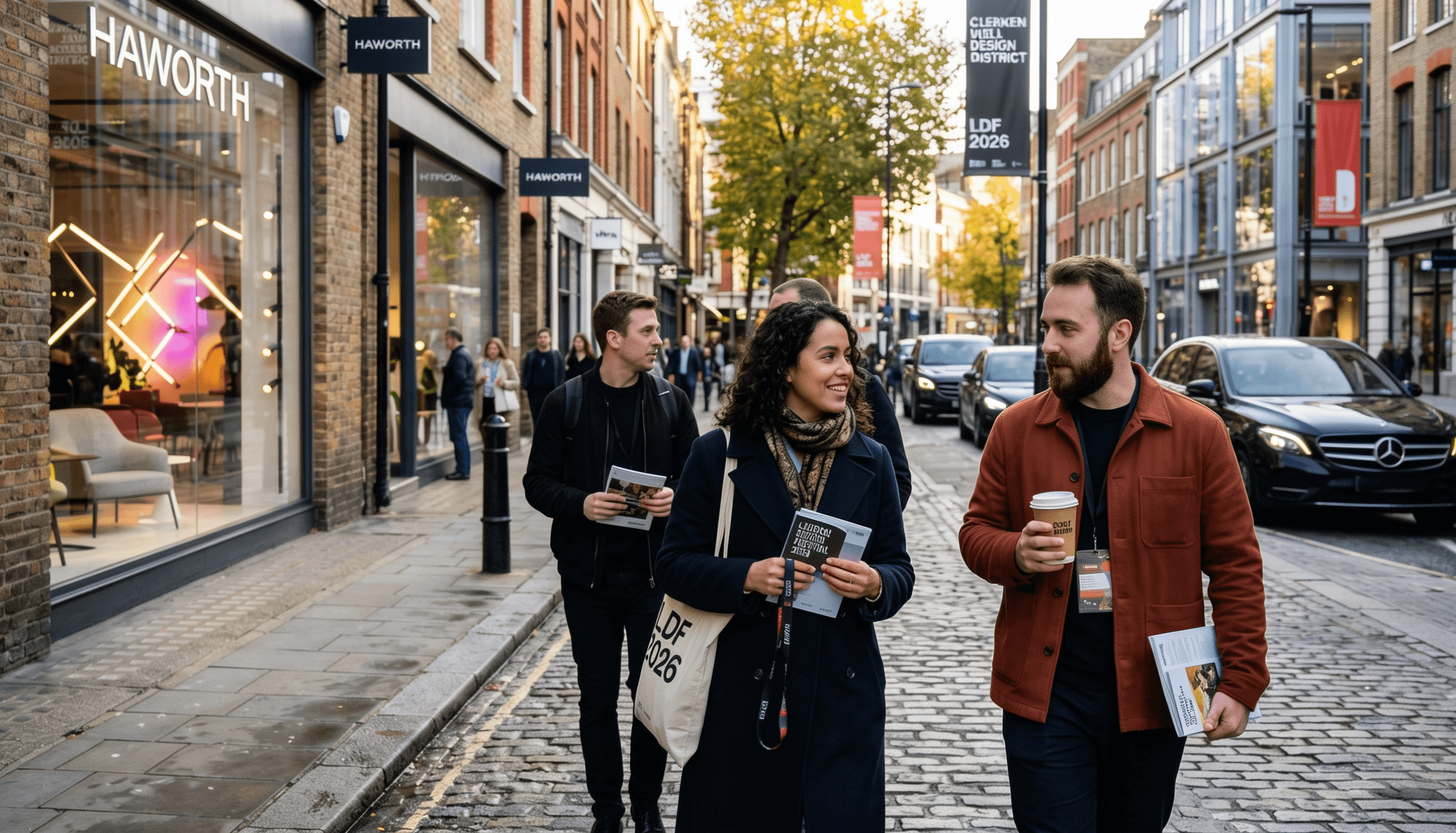
For professionals managing a tight festival schedule, Umbrella Transfers' chauffeur service provides fixed-price, door-to-door transfers across London with English-speaking drivers and 24/7 real-person support. Vehicles range from economy saloons to eight-seat MPVs for group visits. Those arriving in London by air will find airport transfers from all five London airports, with meet and greet included as standard and automatic adjustment to actual landing time. Pre-booking before festival week is advisable: demand in central London increases significantly from 12 September.
Planning by Visitor Type
Choosing Your Route by What You Are There to Do
London Design Festival does not serve a single type of visitor. The most efficient route for an interior designer sourcing furniture collections is not the same as the most useful route for an architect attending specification-focused talks, and neither matches the ideal sequence for a design student attending the festival for the first time. The audience grid below maps each visitor type to the clusters and calendar dates that serve them best.
Interior designers and specifiers
Prioritise the West cluster for luxury showroom sourcing. Brompton, Mayfair, and Chelsea offer the densest concentration of international collections in one walkable area. Add EC1 for material specification. Route One followed by Route Two across two days is the most productive combination.
Architects and design professionals
EC1 is the professional's home district. Fleet Street Quarter and Bankside extend the City and Riverside circuit naturally. The Global Design Forum at the V&A (12 to 14 September) is the week's most significant thought-leadership programme. Pre-register: popular sessions fill well in advance.
Brand buyers and trend forecasters
Shoreditch Design Week (15 to 17 September for the headline venues) is the most concentrated showcase of emerging designers and new product for 2026. Dalston to Stokey adds craft and sustainability-focused studios as a late-afternoon counterpart. International visitors flying in for this specific programme should pre-book transfers from London airports to arrive in time for the 15 September opening.
First-time festival visitors
Start with Route One. The Brompton corridor is the most legible introduction to the festival's character: walkable, dense, and anchored by the V&A. Two districts in a day is the realistic maximum for a first visit without fatigue. Add a second district in the afternoon; leave the outer clusters for a subsequent day.
International visitors with limited time
One day in London for the festival means one cluster. The West cluster covers the most ground in the least travel time. If Shoreditch Design Week is the sole priority, plan for 15 to 17 September and arrive by private transfer from the airport directly to Old Street rather than navigating the Tube from Heathrow with luggage and portfolio cases.
Corporate and group visits
Groups of four or more attending the festival for business travel purposes benefit significantly from pre-booked vehicle coordination. Umbrella Transfers handles group movements up to eight passengers in a single vehicle, with fixed pricing that eliminates per-head fare calculations and keeps the group together between districts and on schedule across a full festival day.
Final Thoughts
The Festival Rewards Those Who Arrive Prepared
London Design Festival is not a passive experience. It requires decisions: which districts, which days, which order. The visitors who leave London at the end of festival week having seen the most are not the ones with the most ambitious lists. They are the ones who made geographically coherent choices and protected their transit time with the same rigour they applied to their programme selection.
For its 24th edition, the festival is larger than it has ever been. Eleven districts, over 400 events, nine days. Soho joins the map for the first time. Shoreditch evolves into a formally structured Design Week with over 60 venues. The opportunity is substantial. So is the risk of wasting a full day crossing the city between venues that, on a map, looked close enough to combine.
Plan by cluster. Confirm your calendar sequencing before you arrive. Pre-book the longer cross-cluster transport legs. If you are flying into London for the festival, the ground leg matters as much as the flight. A pre-arranged airport transfer means you arrive in the city without a luggage detour, without a queue, and without losing the first hour of a festival day to the airport's exit procedures. September is not the month to improvise ground transport in London.
Plan by geographic cluster, not by programme order. Prioritise Shoreditch Design Week on 15 to 17 September for the headline venues. Pre-register for Global Design Forum sessions at the V&A (12 to 14 September). Use the Bloomberg Connects app as your navigational tool on the ground. Pre-book transport for cross-cluster journeys and airport arrivals. The festival does not reward improvisation.
Fixed-price London transfers
Arrive at London Design Festival without the logistics headache
Fixed pricing, meet and greet, and door-to-door service from all five London airports and across the city. Pre-book before festival week fills up.
Book Your Transfer