
Why Moving a Sports Team Is Never Just a Booking Exercise
Anyone who has organised travel for a professional sports team knows that the hardest part is not the flight. The flight is the easy part. The harder part is everything that happens on the ground: the staggered arrivals, the equipment that did not clear customs on time, the driver waiting at the wrong terminal, the player on a separate connecting flight who lands 40 minutes after everyone else. Professional sports travel is, above all, a ground logistics problem.
A Premier League club travelling for a UEFA Champions League fixture typically brings a travelling party of between 50 and 80 people, depending on the competition stage and club budget. That number includes the registered playing squad of up to 25, the head coach and assistant coaches, a goalkeeping coach, a performance analyst, medical staff including the club doctor and physiotherapists, a nutritionist, a kit manager and kit staff, media and communications personnel, and in some cases, club directors or commercial executives. A Premiership Rugby club in European Champions Cup competition operates on a similar scale, with a match-day squad of 23 players and 8 replacements, supported by a comparable support infrastructure. The total travelling party for a top-level European fixture routinely exceeds 60 people, with some clubs travelling closer to 80 when media and commercial staff are included.
Professional sports team travel is not managed at the point of arrival. It is planned weeks in advance, with contingency built in for every stage. The ground leg is where that planning is tested.
The Travelling Party
Who Actually Travels and What They Need on Arrival
The composition of a professional sports travelling party is more structured than most outsiders assume. Each group within it has a distinct operational priority on arrival, and those priorities do not always align with a single, coordinated exit from the terminal.
Players are the obvious headline. But in terms of airport logistics, players are often the straightforward element. They travel together, they have personal bags rather than complex freight, and their priority is a smooth, private, low-friction exit to a waiting vehicle. The more operationally demanding groups are the kit staff, the medical team, and the analysts. Kit staff typically travel with multiple large equipment cases containing match kit, training kit, boots, spare studs, bibs, cones, and recovery equipment. Medical staff carry a clinical bag that may include controlled medications requiring customs documentation. Analysts travel with laptop equipment, sometimes specialist video analysis hardware, and data connections that need to be established at the hotel ahead of any tactical meeting.
"In professional football, travel is considered a structural component of the team system. A poorly managed away trip is not just inconvenient: it becomes a risk factor."Flyness Sports Travel, 2026
Media staff add a further layer. A club travelling with a content team will often bring camera operators, social media staff, and a press officer whose schedule is governed by UEFA or competition broadcast requirements rather than by the coach's itinerary. These staff may need to be at the stadium hours before the squad arrives. Planning for separate vehicle timings is not optional. It is the baseline.
Equipment and Cargo
The Logistics of Kit, Equipment, and Specialist Cargo
Players travel light by the standards of their own support operation. The same is not true of what surrounds them. A professional football club's kit manager will typically transport a significant volume of specialist cargo for any European fixture, and the planning required for that cargo is entirely separate from the passenger operation.
Kit Skips and Equipment Cases
Premier League clubs routinely use Zarges aluminium travel skips to transport match and training kit. These lockable, branded cases stack efficiently but require dedicated freight handling and are not standard passenger luggage. A full kit operation for 23 players plus squad can involve eight to twelve cases.
Medical and Recovery Equipment
Club medical staff travel with clinical supplies, physiotherapy equipment, ice and compression recovery kit, and in some cases portable ultrasound or assessment devices. Items containing controlled substances require pre-cleared customs documentation and cannot be managed at the terminal on the day.
Analytical and Broadcast Equipment
Performance analysis hardware, video review systems, and media production equipment now form a standard part of any professional club's travel manifest. This equipment often needs to be set up at the hotel the night before the game, making prompt and secure delivery to the accommodation a priority.
For rugby clubs, the equipment challenge is amplified by the physical nature of the sport. Scrum machines, tackle bags, and specialist training apparatus may travel separately by freight, departing days before the squad. The match-day kit operation itself, covering 23 players with multiple sets of jerseys, shorts, socks, and position-specific protective equipment, is comparable in scale to football but with additional considerations around padded garments and contact equipment that may attract additional inspection at security.
London Airport Profiles
Which London Airport and Why It Changes the Ground Plan
London is served by four commercial airports that professional sports teams regularly use for arriving fixtures: Heathrow, Gatwick, Stansted, and London City. Each presents a different operational profile, and the choice of arrival airport has direct consequences for the ground transport plan. Features below are verified against current airport operations as of July 2026.
| Airport | Distance to Central London | Terminal Complexity | Charter / Private Infrastructure | Peak Congestion Risk | Typical Drive to North/West London Stadiums | Typical Drive to South/East London Stadiums |
|---|---|---|---|---|---|---|
H Heathrow |
23 km west | Limited FBO, mainly commercial | ✗ High at peak hours | 25–55 min | 45–90 min | |
G Gatwick |
45 km south | Charter-friendly, South Terminal | Moderate | 60–90 min | 35–60 min | |
S Stansted |
60 km northeast | ✓ 5 dedicated FBOs, VIP terminals, 24/7 | ✓ Low, especially overnight | 60–90 min | 60–100 min | |
LC London City |
11 km east | Executive use, aircraft size limited | ✓ Very low | 35–60 min | 15–30 min |
Heathrow handles around 83.9 million passengers per year and operates across four active terminals (T2, T3, T4, and T5), with T1 currently closed for refurbishment. The distances between terminals are among the longest of any airport in Europe. For a sports team arriving on a commercial flight into T5 while their equipment is being processed through a separate freight channel, coordination requires explicit pre-arrival planning. Meet and greet is standard and mandatory at Heathrow, which supports controlled arrivals, but the volume of passenger traffic means that a well-briefed ground transport operation is essential. Stansted, by contrast, handles around 28 million passengers annually and offers five dedicated fixed-base operators (FBOs) for private and charter aviation, including Inflite Jet Centre, Harrods Aviation, and Universal Aviation. Clubs arriving on charter flights at Stansted can access on-site customs clearance, VIP terminal facilities, and vehicle access directly from the apron, making it the most operationally efficient entry point for charter arrivals. London City suits smaller executive delegations and is the closest airport to the City and Canary Wharf, but its short single runway limits aircraft size, making it unsuitable for full squad charters. Gatwick's dual-terminal layout (North and South, connected by a transit shuttle) requires explicit terminal confirmation before any ground transport is positioned.
Operational Planning
The Ground Transport Plan: What Needs to Be Decided Before the First Flight Lands
Ground transport for a professional sports team is not arranged the morning of travel. It is confirmed days before departure, with vehicle types, driver briefings, meet and greet coordination, and contingency plans already in place. The difference between a well-executed arrival and a logistically chaotic one is almost always the quality of the pre-departure planning, not the effort applied on the day.
A travelling party of 60 to 80 people requires a fleet of vehicles rather than a single coach. The standard configuration for a Premier League or Premiership Rugby squad involves a minimum of one full-size executive coach for players and coaching staff, one to two minibuses or people carriers for medical, analytical, and media staff, and a separate vehicle for equipment if it cannot travel with the squad. Vehicles must be confirmed with exact seating capacity, not approximate, because sports teams do not accept under-provisioned transport.
For clubs with high-profile players, the requirement for darkened windows or private passenger vehicles also needs to be confirmed in advance. Privacy is a standing requirement for many top-flight clubs, particularly when arriving in cities where opposition fan activity is possible near the airport or hotel route.
Professional clubs rarely travel as a single group on a single flight, particularly when arriving via commercial aviation rather than charter. Coaching staff and players may arrive on different flights, with media travelling separately and equipment cleared through a separate freight channel. This means a ground transport team managing three or four separate arrivals, each with different estimated landing times, different terminal locations, and different luggage volumes.
Flight monitoring is not a convenience. It is a prerequisite for accurate vehicle positioning. A flight delayed by 45 minutes means a driver and vehicle parked at significant cost, and potentially blocking or confusing the pick-up operation for a second flight arriving at a different terminal simultaneously. Real-time flight tracking, with ground transport adjusted automatically as landing times change, eliminates the most common point of failure in professional sports arrivals.
Meet and greet at arrivals is a standard expectation for professional sports teams, not a premium upgrade. At Heathrow and Gatwick, it is the mandatory mode for all transfer pick-ups. The operational value for a sports team is significant: a named driver with a board waiting at the arrivals exit removes the delay caused by 25 players and 20 support staff all looking for different vehicles in an unfamiliar terminal.
For clubs with specific privacy requirements, a meet and greet approach also allows a controlled exit route to be pre-confirmed with the driver, reducing exposure to public areas within the terminal. At Stansted's FBO terminals, the process is even more direct, with vehicles able to access the airside area for charter arrivals and reduce terminal dwell time to a minimum.
Airport to hotel is only the first leg. Professional sports teams operating on a tight pre-match schedule will also need stadium transfers, and in many cases a separate pre-match training ground visit the day before the fixture. These onward legs need to be integrated into the same ground transport plan. A driver who handles the airport arrival and then remains on standby for the hotel-to-training-ground movement eliminates a handover point and reduces the risk of scheduling confusion between multiple operators.
Fixed pricing, flight tracking, and meet and greet as standard for groups of any size arriving at any London airport.
Book Your TransferCommon Failure Points
Where Sports Team Airport Arrivals Go Wrong
The most experienced sports travel managers will confirm that the same failure points recur across teams and competitions. They are rarely dramatic. They are structural: gaps between planning and execution at the point where one responsible party hands off to another.
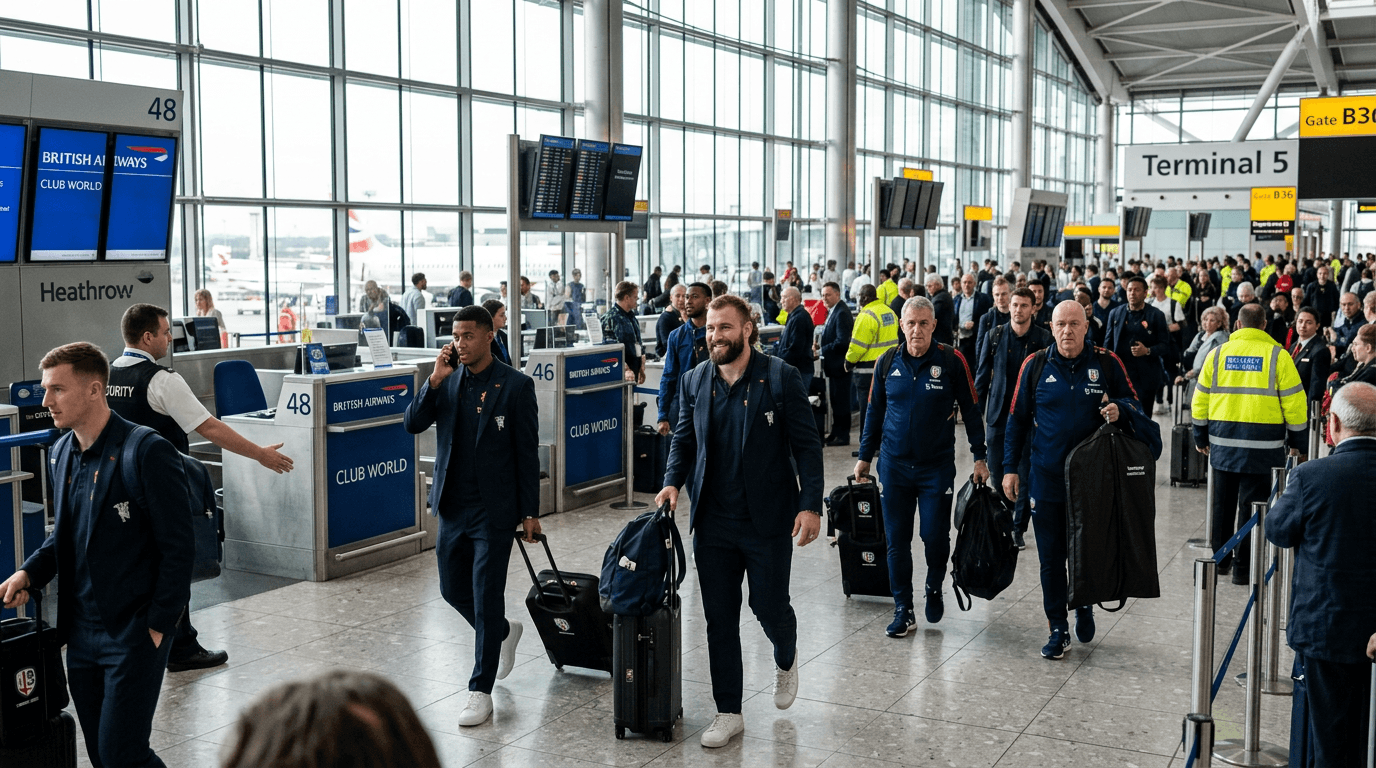
The most reliable signal of a transfer provider experienced in group and professional travel is not the size of their vehicle fleet. It is whether they ask, before confirming the booking, for the flight number, the terminal, the exact headcount, and whether any freight is travelling separately.
Transfer Planning by Role
Choosing the Right Transport Approach by Travel Group
Not every member of a professional sports travelling party needs the same transport solution, and experienced travel managers plan by group rather than by headcount. The distinctions matter on arrival day.
Players and Coaching Staff
The core group, typically 25 to 35 people, needs a coordinated, private exit from arrivals to a waiting executive coach or fleet of people carriers. Privacy, speed of exit, and a named meet and greet contact are the priorities. Luggage assistance from the terminal to the vehicle is standard expectation at this level. Umbrella Transfers provides meet and greet as standard with English-speaking drivers, and operates vehicles suited to group travel including up to eight passengers per vehicle across both economy and executive options.
Medical and Kit Staff
This group often has the most complex logistics on arrival, combining personal baggage with specialist equipment cases. A separate vehicle or fleet operating on a slightly delayed schedule (to allow for equipment clearance) is often the most practical approach. Confirmed luggage assistance and a driver briefed on the volume of cargo are prerequisites, not preferences.
Analysts and Technical Staff
Technical staff carrying analysis hardware and video equipment need a direct route to the hotel rather than via the stadium, and may need early check-in guaranteed to allow equipment setup ahead of the evening tactical session. A transfer provider with real-time 24/7 support can coordinate this directly with the hotel, reducing the administrative burden on the club travel manager.
Media and Communications Teams
Media staff routinely operate on a separate schedule from the playing party, with broadcast obligations that may require them at the stadium significantly before the squad. A separate vehicle booking on a different timing, confirmed independently, is the appropriate solution. Bundling media into the squad transfer is one of the most consistent sources of logistical friction for clubs at European level.
Visiting International Clubs
Clubs arriving from outside the UK face additional considerations: unfamiliar road networks, potential language barriers, customs clearance for specialist equipment, and no existing relationship with the hotel or local transport infrastructure. For these groups, a transfer provider with 24/7 real-person support, English-speaking drivers, and experience of UK airport logistics removes the most significant points of friction at the start of a demanding travel day.
Club Directors and Commercial Executives
Club executives and commercial delegates often travel on separate flights, sometimes arriving from different cities or countries to converge in London before the match. An executive vehicle booked independently from the squad operation, with flight monitoring and a confirmed meet and greet, handles this group cleanly without the coordination overhead of a multi-stop pickup arrangement.
Final Thoughts
The Ground Leg Is Where the Plan Either Holds or Unravels
Professional sports travel management has become, in the past decade, an increasingly sophisticated discipline. Clubs at the top level now treat travel as a performance variable, not a logistical afterthought. Flight selection is made with recovery time in mind. Nutrition is planned for in-transit and post-landing. Hotel arrivals are timed around the tactical session, not around convenience. Within that framework, the ground leg through the airport is the one phase where the planning is most often under-specified and most often where avoidable problems occur.
The airport ground operation is the first thing players and staff experience in the host city. A smooth, quiet exit from arrivals, vehicles staged and waiting, drivers who know the headcount and have a contact number for the travel manager: this is what a well-organised arriving sports team experiences. The alternative is a group of 60 people standing in an arrivals hall while someone makes phone calls. The difference between the two is not cost. It is planning.
For clubs, travel managers, and team operations staff coordinating fixtures that bring a professional squad through London's airports, Umbrella Transfers operates across all five London commercial airports with fixed pricing, real-time flight monitoring, meet and greet as standard, and 24/7 real-person support. Group capacity extends to eight passengers per vehicle. For larger travelling parties, a coordinated fleet can be arranged ahead of arrival. The booking engine is at booking.umbrellatransfers.com.
Confirm terminal assignment before travel, not on arrival day. Book by flight number, not by estimated time. Separate media and equipment staff from the squad vehicle. Choose a provider with 24/7 real-person support and confirmed meet and greet. The ground leg is manageable. It just needs to be planned.
Fixed-price group transfers
Arrive at any London airport ready to perform, not to problem-solve
Meet and greet as standard, real-time flight monitoring, 24/7 support, and fixed pricing across all five London airports.
Book Your Transfer