Why Visitors Feel Uncertain About Tipping in the UK
You step off a long-haul flight at Heathrow or Gatwick, your driver is waiting in arrivals with your name on a card, the journey is smooth, and the luggage is already in the boot. As you near your destination, a familiar anxiety surfaces: should you tip? How much? Will it cause offence to offer too little, or will it seem presumptuous to hand over a large gratuity? For visitors from the United States, Canada, the Middle East, or parts of Europe, tipping is either a social contract or an expected ritual. In the UK, it is neither.
British tipping culture operates on a different foundation entirely. Drivers, chauffeurs, and service workers are paid at least the National Living Wage, which rose to £12.71 per hour in April 2026. Tips are not factored into base pay. A gratuity is a genuine optional bonus for service that exceeded expectations, not a mechanism to subsidise income. Understanding that distinction removes the uncertainty immediately. You are not withholding something owed. You are deciding whether to offer something extra.
This guide explains what UK tipping customs actually look like, how chauffeur services differ from ordinary taxi journeys, what visitors from high-tipping cultures most commonly misread, and how to handle the moment confidently, whichever way you decide.
In the UK, a tip is a reward for service that stood out. It is not a social obligation, a wage supplement, or a signal that the basic transaction was acceptable. A chauffeur who receives no tip at the end of a professional journey has not been slighted.
Context
How UK Tipping Culture Differs from the Rest of the World
The confusion experienced by international visitors is entirely understandable, because tipping norms vary more dramatically across countries than almost any other social custom. In the United States, tipping between 18% and 22% at a restaurant is not generosity, it is obligation. Many American servers earn a federal tipped minimum wage as low as $2.13 per hour, and tips constitute the majority of their income. Arriving in the UK and applying the same logic produces a significant overshoot, and occasionally an awkward moment for both parties.
Canada operates similarly to the US, with 15% to 20% standard at sit-down restaurants, though provincial minimum wages are higher. In Australia, tipping is less structured: 10% to 15% at nicer restaurants is appreciated but not demanded, and for transport the norm is closer to rounding up or not tipping at all. Across much of continental Europe, service charges are often built into bills, and leaving 5% to 10% when they are not is common in France and Germany but not expected in Spain or Scandinavia. In the Gulf states, Qatar, Saudi Arabia and the UAE sit closest to American norms for the hospitality sector, with 15% to 20% expected for good service in hotels and restaurants.
The UK sits in a distinct position. Service workers receive the full national minimum wage as a guaranteed baseline, and the Employment (Allocation of Tips) Act 2023, which came fully into force on 1 October 2024, now requires that any tips collected by employers are passed on to workers in full, fairly and transparently. Tips are taxed as income, not treated as informal supplementary pay. The result is a culture where a tip carries genuine meaning precisely because it is not automatic. When a British person tips, it is a considered act. When they do not, nothing has gone wrong.
"In the UK, a tip says the service was genuinely worth noticing. That carries more weight than a percentage applied by default."Umbrella Transfers Editorial
Key Distinctions
Chauffeurs, Private Hire Drivers and Taxis: the Differences That Matter
Not all transport providers in the UK occupy the same category, and the distinction matters when thinking about tipping expectations. A London black cab, hailed on the street or at a rank, is a metered service. Rounding up the fare or adding 10% to 15% is the accepted gesture, and most passengers simply tell the driver to keep the change. A private hire vehicle booked through an app such as Bolt operates on a similar premise: optional in-app tips of 5% to 10% are common but not expected, and many passengers tip nothing on routine journeys without any social awkwardness.
A professional chauffeur service is a different category altogether. The fare is fixed in advance. The vehicle is typically executive class. The driver is a trained professional whose role extends beyond navigation to include luggage assistance, meet and greet coordination, flight monitoring, and a level of discretion expected in business and luxury travel. The service is priced to reflect all of this. A tip on a chauffeur booking is therefore not a correction for low wages or a supplement to a metered fare. It is a personal acknowledgement of service that stood out.
Three practical markers distinguish a chauffeur engagement from a standard taxi hire, and each one shapes how tipping decisions are framed correctly.
Fixed pricing
A professional chauffeur fare is agreed before the journey. There is no meter running, no surge pricing, and no ambiguity. The price covers the full service.
Flight and delay monitoring
For airport transfers, a chauffeur service tracks the actual flight and adjusts pickup timing accordingly. Waiting time from the point of landing is included as standard.
Professional meet and greet
The driver meets the passenger in the arrivals hall, often with a name board, assists with luggage, and guides the passenger to the vehicle. This is a service standard, not an upgrade.
Practical Reference
When Tipping Is Appropriate, When It Is Not, and How Much
The clearest guidance is to tip when something specific impressed you, and not to tip when the service met expectations competently. Both positions are entirely acceptable. What follows is a practical breakdown verified against current UK norms.
| Situation | Tip appropriate? | Suggested amount | Notes |
|---|---|---|---|
| Excellent chauffeur service, smooth journey, luggage assistance | ✓ | 5–10% of fare, or £5–£10 flat | Cash preferred; a genuine gesture, not an expectation |
| Exceptional service: early arrival in adverse conditions, extra care, notable helpfulness | ✓ | 10–15% of fare | Appropriate when the driver clearly went beyond the standard brief |
| Standard professional journey, competent and courteous | Optional rounding up or nothing | Not tipping is entirely acceptable; the fare reflects the service | |
| Corporate or business travel booking | Check company policy first | Many corporate accounts handle gratuity separately or include it; tipping on company account requires approval | |
| Airport transfer with flight delay wait and smooth coordination | ✓ | £5–£10 flat | Especially appropriate where the driver waited patiently through a long delay |
| Unsatisfactory service, late, unhelpful, vehicle not clean | ✗ | No tip required | Leave a review instead; feedback reaches the company where a withheld tip does not |
| Pre-booked transfer with service charge or gratuity already included | ✗ | No additional tip needed | Check the booking confirmation; additional tipping would be doubling a payment already made |
Most reputable UK chauffeur companies do not add a gratuity line to their invoices automatically. Check the booking confirmation before deciding. If a service charge has already been applied, additional tipping is not expected and not necessary.
Professional Standards
What Professional Chauffeur Services Expect and How Umbrella Transfers Approaches It
Reputable UK chauffeur companies are built on a premise that tips are welcome but the service standard never depends on them. The pricing model reflects the full cost of a professional, reliable journey. The driver's conduct, the vehicle standard, the coordination on the day: none of these vary based on whether a gratuity follows.
As one example of how this operates in practice, Umbrella Transfers covers London's major airports including Heathrow, Gatwick, Stansted, Luton and London City, as well as regional airports and UK-wide routes. Fixed pricing is confirmed at booking. Meet and greet is included as standard. Flight monitoring ensures the driver adjusts to the actual landing time, and free waiting time runs from the point of landing. English-speaking drivers assist with luggage and are available around the clock. Tips are welcomed. They are not built into the service expectation.
A tip after an airport run where the driver waited through a two-hour delay, helped with four large cases, and navigated a change of terminal without complaint is a meaningful gesture. A tip on a routine transfer where everything went precisely as expected is entirely optional and will not be missed.
Fixed pricing
The fare agreed at booking is the fare paid. No surge pricing, no meter ambiguity, no end-of-journey surprises. Tipping decisions are made from a clear baseline.
Meet and greet included
Drivers meet passengers in arrivals with a name board and assist with luggage to the vehicle. This is a standard, not a premium add-on.
Flight monitoring
Actual landing time drives the pickup. Passengers are not charged for delays outside their control, and waiting time from landing is included.
24/7 real-person support
A human is available at any hour if the journey changes, the flight is diverted, or any coordination is needed. Automated responses are not part of the model.
Fixed-price airport transfers across the UK, with meet and greet included as standard.
Book Your TransferCultural Context
What Visitors From High-Tipping Cultures Most Commonly Get Wrong
The mistakes are almost always in one direction: over-tipping, or assuming the absence of a tip has caused offence. Both misread the situation. Understanding exactly where the confusion originates for each major visitor group makes the adjustment straightforward.
Practical Guidance
Cash, Card and Alternatives: How to Handle the Moment Gracefully
Knowing what to tip is only part of the picture. Knowing how to handle it, when the journey ends and you are standing next to your luggage outside arrivals or a hotel entrance, matters as much as the amount. The mechanics are straightforward once the cultural register is understood.
Cash tips
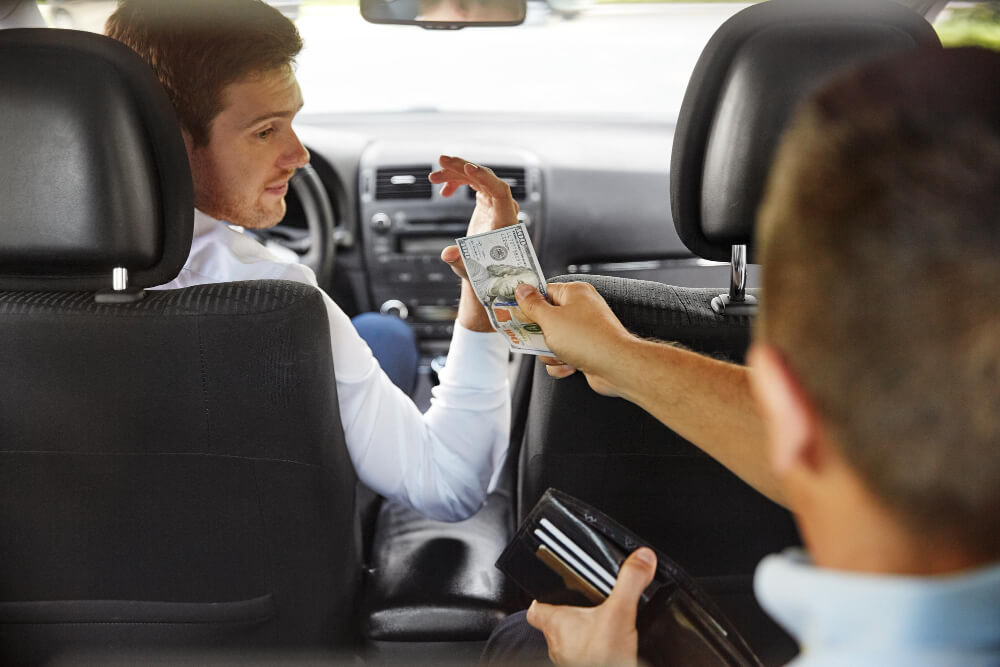
Cash is the preferred method across UK private hire and chauffeur services. It reaches the driver immediately and requires no processing. Having a few small notes, £5 or £10, available for moments where you want to tip is practical. There is no obligation to have exact change: rounding up to a convenient figure is entirely normal.
Card or app-based tips
Some chauffeur booking platforms allow a gratuity to be added at the card payment stage or after the journey via an app. This is a valid method, though drivers generally note that cash is preferred because it is immediate and direct. If paying entirely by card and the option is offered, 5% to 10% is appropriate for excellent service.
The verbal acknowledgement
A genuine, specific compliment at the end of the journey carries real weight in the UK. "Excellent drive, thank you, very smooth journey" said clearly and sincerely is not a consolation prize for not tipping. For many drivers, it is valued as much as a modest financial gratuity. The two can of course be combined.
Leaving a positive review
A detailed, honest review on Google or TrustPilot naming the driver by first name and describing what made the journey stand out is a meaningful alternative to tipping. It generates direct business benefit for the driver and the company, it is visible to future passengers, and it takes two minutes. For international visitors who want to show appreciation beyond the journey itself, a review is often the most impactful gesture available.
Business travel
On corporate bookings, gratuity is often settled separately through the account or travel management company. If you are travelling on a company account, check whether tipping is covered by the booking or whether personal cash tips are permitted under your company's travel policy. When in doubt, ask your travel coordinator before the journey rather than at the end of it.
Airport transfers specifically
The airport transfer context, arriving at Heathrow after a long-haul flight with multiple bags and navigating a busy terminal, is the scenario where an exceptional driver makes the most noticeable difference. If the driver waited through a delayed flight, helped with heavy luggage, and got the routing right without fuss, that is a moment where a tip of £5 to £10 is a natural response. If the transfer was straightforward and smooth, no tip is needed.
Final Thoughts
Confidence Is the Simplest Approach to UK Tipping
The anxiety around tipping in an unfamiliar country is almost always worse than the reality. In the UK, the cultural expectation placed on a visitor is simply this: pay the fare, be courteous, and tip if something genuinely stood out. That is not a complicated standard to meet. No one is watching, no social contract is in jeopardy, and no driver will be offended by a thoughtful passenger who paid a fair fixed price and said thank you warmly at the end.
Professional chauffeur services in the UK are built around a standard that does not fluctuate based on gratuity. The driver who meets you in the arrivals hall at Gatwick with your name on a card, helps with your cases, monitors your delayed flight without prompting, and delivers you smoothly to your hotel is performing exactly as the service was designed to. A tip after that journey is a genuine personal gesture. Its absence is not a slight. Both positions are equally correct.
For visitors from cultures where tipping is embedded in the economics of service, the adjustment is less about learning a new rule and more about releasing an old anxiety. The UK system is not more complicated. It is simply more discretionary. Treat it that way, and the question of whether to tip resolves itself naturally at the end of every journey.
Tip 5% to 10% for excellent chauffeur service, or a flat £5 to £10 for an airport transfer that went beyond the expected brief. Pay nothing without embarrassment if the service was professional and complete. Leave a detailed positive review if the driver made a real difference. Check corporate travel policies before adding gratuity to a business booking. Cash is preferred over card for tips in all private hire contexts.
Fixed-price UK airport transfers
Professional service where the standard never depends on a tip
Meet and greet included, flight monitoring as standard, fixed pricing confirmed at booking, 24/7 real-person support across all major UK airports.
Book Your Transfer