Where Heathrow Is, Who Runs It, and What Has Changed for 2026
Heathrow can feel less like an airport and more like a small city you have been dropped into without a map. The terminals spread across a wide site, the rules seem to change every year, and most of the advice online is either out of date on price or buried in officialese. This guide pulls together what actually matters in 2026, so that every decision after it becomes simpler.
The airport sits about 14 miles west of central London, in the London Borough of Hillingdon, near Hounslow and the village of Harmondsworth. Its postcode is TW6, and the area falls within the historic county of Middlesex. It is firmly part of Greater London rather than a separate town, which answers the question so many travellers type before they land: yes, Heathrow is in London. The year just gone was its busiest ever. More than 84.5 million passengers passed through in 2025, and it held its place as the most punctual major hub in Europe.
Heathrow is privately owned and run by Heathrow Airport Holdings, under a consortium known as FGP TopCo. That consortium changed in late 2024, when Spain's Ferrovial sold the bulk of its long-held stake. The largest shareholder is now the French investment house Ardian, alongside the Qatar Investment Authority, Saudi Arabia's Public Investment Fund, Singapore's GIC and Canada's CDPQ. Private ownership does not mean private rules, because the Civil Aviation Authority still regulates safety, charges and service standards. The airport runs around the clock, subject to a night flight restriction, though individual terminals, check-in desks and shops keep their own hours.
Heathrow is vast but well connected, and tightly regulated despite being privately run. Once you know your terminal and how you are getting into London, almost everything else falls into place.
Terminal Overview
Inside the Four Terminals: How Heathrow Is Laid Out
The fastest way to make Heathrow feel manageable is to understand its shape before you arrive. The airport has four passenger terminals in use, numbered 2, 3, 4 and 5. Terminal 1 closed to flights in 2015 and is being cleared to make room for a future expansion of Terminal 2, so anyone still searching for it can stop looking. There is no Terminal 1 today.
Terminals 2 and 3 sit together at the centre of the airport and are linked by an underground walkway, which makes changing between them the easiest move on site. Terminals 4 and 5 stand on opposite edges and are reached by the free inter-terminal train, not on foot. Getting the terminal right before you travel removes the most stressful kind of last-minute dash.
Terminal 2
The Queen's Terminal, opened in 2014 and the newest and most compact. Home to Star Alliance carriers such as Lufthansa, United, Air Canada and Singapore Airlines.
Terminal 3
Heathrow's oldest terminal still in service, dating to 1961. A long-haul base for Virgin Atlantic, American Airlines, Emirates and Delta.
Terminal 4
On the southern perimeter, reached by the transfer train. Used by many SkyTeam and independent carriers, including KLM, Qatar Airways and Korean Air.
Terminal 5
Opened in 2008 with two satellite buildings, 5B and 5C. The primary home of British Airways, with some BA flights also using Terminal 3.
Airline Terminal Finder
Which Terminal Does Your Airline Use at Heathrow?
No question is asked more often at Heathrow, and the honest answer carries one caveat. Airlines are grouped by alliance across the terminals, but assignments can shift during disruption or for specific routes, so the boarding pass and the airline app are always the final word. The table below reflects the usual position for 2026, checked against airline and airport information, and it covers the carriers travellers ask about most.
| Airline | Usual terminal | Good to know |
|---|---|---|
| British Airways | Terminal 5 | Primary hub; some flights use Terminal 3 |
| Virgin Atlantic | Terminal 3 | Long-haul transatlantic base |
| American Airlines | Terminal 3 | oneworld |
| Emirates | Terminal 3 | Dubai and connections |
| Delta Air Lines | Terminal 3 | SkyTeam, transatlantic |
| United Airlines | Terminal 2 | Star Alliance; occasionally Terminal 3 |
| Lufthansa | Terminal 2 | Star Alliance |
| Air Canada | Terminal 2 | Star Alliance |
| Singapore Airlines | Terminal 2 | Star Alliance |
| Turkish Airlines | Terminal 2 | Star Alliance |
| ITA Airways | Terminal 2 | Joining Star Alliance in 2026 |
| Eurowings | Terminal 2 | European routes |
| Qatar Airways | Terminal 4 | oneworld, based at Terminal 4 |
| KLM | Terminal 4 | SkyTeam |
| Air France | Terminal 4 | SkyTeam |
| Korean Air | Terminal 4 | SkyTeam |
| Iberia | Terminal 5 | Shares the British Airways group home |
When in doubt, check on the morning of travel. Heathrow's own terminal finder and your airline will confirm the gate, and a good transfer service will track it for you.
Transport Options
Getting From Heathrow to Central London and Beyond
Arriving is rarely the hard part. The real test starts at the terminal exit, when you are tired, holding luggage, and deciding how to cover the last 14 miles into London. Heathrow has more transport links than almost any airport in the world, which is a relief once you know which one suits your situation and a source of dither when you do not.
The Heathrow Express is the fastest public route, running non-stop to London Paddington in about 15 minutes from Terminals 2 and 3, and around 21 minutes from Terminal 5, every 15 minutes through the day. Walk-up fares are steep, but advance tickets booked ahead start from around 10 pounds, and under-15s travel free. It does not serve Terminal 4, where you change at Terminals 2 and 3. The Elizabeth line is the option many travellers now choose by default. It reaches Paddington in about 28 minutes for roughly 14 pounds on contactless, then carries on through the West End, the City and Canary Wharf without a change, serving all four terminals. The Piccadilly line is the cheapest rail route, calling at every terminal and reaching central London in about 45 to 50 minutes, slower and tighter on luggage space but hard to beat on price.
Licensed black cabs wait at ranks outside every terminal, metered and available without booking, usually costing somewhere between 55 and 100 pounds to central London depending on traffic and destination. The Central Bus Station serves National Express and local coaches for travellers heading beyond London. For drivers, Heathrow sits on the M4 and M25, and there is one change worth flagging. From 1 January 2026 the terminal drop-off charge rose to 7 pounds per visit, with a strict 10-minute limit and an 80 pound penalty, reduced to 40 pounds if paid promptly, for missed payments. The free Park and Ride avoids the forecourt entirely.
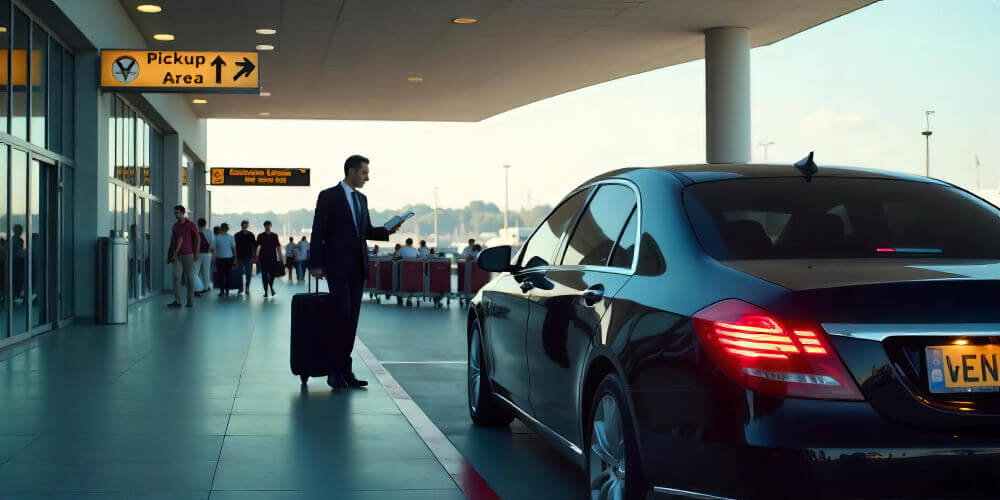
Pre-booked private transfers sit apart from all of these. The fare is fixed and agreed before travel, the driver tracks the flight and adjusts for delays, and the service runs door-to-door with help for every bag. Operators such as Umbrella Transfers build their service around the exact moments that catch travellers out at Heathrow: a delayed landing, a heavy case, a group that will not fit in one cab, or an arrival long after the trains have thinned out.
| Option | Time to central London | Typical cost | Door-to-door | Luggage help | Fixed price | All terminals |
|---|---|---|---|---|---|---|
| Heathrow Express | ~15 min to Paddington | From 10 pounds advance | ✗ | ✓ | ||
| Elizabeth line | ~28 min to Paddington | ~14 pounds contactless | ✗ | ✓ | ✓ | |
| Piccadilly line | ~45 to 50 min | Lowest fare | ✗ | ✗ | ✓ | ✓ |
| Black cab | ~40 to 60 min | ~55 to 100 pounds metered | ✓ | ✓ | ✗ | ✓ |
| Pre-booked transfer | ~40 to 60 min | Fixed when you book | ✓ | ✓ | ✓ | ✓ |
Fixed-price Heathrow transfers with meet and greet, flight tracking and help with every bag, across London and the UK.
Book Your TransferApp-Based Travel
Which Ride-Hailing Apps Actually Work at Heathrow
Plenty of travellers land at Heathrow, open the app they use at home, and find nothing comes up. The ride-hailing market in the United Kingdom is narrower than in many countries, and several well-known apps simply do not operate here. Knowing which ones work before you land saves a frustrating wait by the arrivals door.
Uber operates at Heathrow through designated pickup zones rather than kerbside collection, and as of January 2026 its London fares carry 20% VAT, which has pushed typical prices up. Bolt operates across London and often undercuts Uber. Free Now connects to the city's licensed black cabs and private hire and is widely used. Beyond those, the picture thins fast. Lyft does not operate in the United Kingdom at all. Didi and Grab do not serve London either, despite their scale elsewhere, and Ola has scaled its UK presence back to the point where it is not a dependable airport option.
| App | Works at Heathrow? | Good to know |
|---|---|---|
| Uber | Yes | Designated pickup zones; 20% VAT on London fares from 2026 |
| Bolt | Yes | Operates across London, often cheaper than Uber |
| Free Now | Yes | Black cabs and licensed private hire |
| Ola | Limited | UK presence reduced, not reliable for airport runs |
| Lyft | No | Operates in North America only |
| Didi | No | Not available in the United Kingdom |
| Grab | No | Operates in Southeast Asia only |
Every app-based option shares the same weak spot at an airport. Nothing is guaranteed. Surge pricing can spike at the worst moment, a driver can cancel as you reach the front of the rank, and none of them watches your flight. A pre-booked transfer removes that uncertainty, because the price is fixed when you book, the driver is assigned in advance, and with a service such as Umbrella Transfers the pickup is adjusted automatically when the flight lands early or late.
Before You Fly
Security Opening Times, Liquids Rules, and How Early to Arrive
The questions that fill search engines at 3am are the practical ones. When does security open, how early should you arrive, and what can be carried through. Here are the current answers, with the parts that changed for 2026 flagged clearly. Heathrow does not run on a single fixed opening time. Security at each terminal opens in line with the first departures of the day, which in practice means somewhere between 4:00am and 4:30am, with Terminal 5 often the earliest given British Airways' early long-haul schedule. Check-in desks usually open about three hours before each flight, and face coverings are no longer required anywhere in the airport.
| Terminal | Security typically opens | Notes |
|---|---|---|
| Terminal 2 | Around 4:30am | Aligned to the first Star Alliance departures |
| Terminal 3 | Around 4:30am | Long-haul carriers, confirm with your airline |
| Terminal 4 | Around 4:30am | Reached by the transfer train, allow extra time |
| Terminal 5 | From around 4:00am | Often earliest for British Airways long-haul |
Liquids and electronics in 2026
Heathrow has rolled out next-generation CT scanners across its terminals, and the current position is that liquids in containers up to two litres, and laptops, can stay in your bag through security. The rule has been tightened and relaxed more than once in recent years, so the safe approach is to check the latest guidance shortly before you fly and, if in any doubt, pack to the older 100ml standard. Baby food and essential medicines remain exempt and may be screened separately.
Arrive about three hours before a long-haul or international flight, and around two hours before a short-haul or domestic one. For connections, follow the purple transfer signs, and remember that some airlines through-check baggage while others ask you to collect and re-check it.
Facilities
Lounges, Dining, Shopping, and Where to Rest Between Flights
A long layover at Heathrow does not have to be endured. The airport has spent years positioning itself as a destination in its own right, and for travellers with time to fill, that effort shows in every terminal.
Lounges
Airline and pay-on-the-day lounges, from the British Airways Galleries spaces to Plaza Premium, offer quiet seating, showers and food away from the concourse.
Dining
Choices run from a quick Pret to a sit-down meal at Gordon Ramsay's Plane Food in Terminal 5, with strong options in every building.
Shopping
Premium names such as Harrods, Burberry and Gucci sit alongside the everyday essentials at Boots and WHSmith.
Resting
On-site hotels including Sofitel at Terminal 5 and options along the Bath Road suit overnight stops, and compact sleep-pod rooms have operated at Terminal 4 for short rest. Check current availability before relying on them.
Time at Heathrow is only wasted if you treat it as waiting.
Final Thoughts
Final Thoughts: Heathrow Rewards the Prepared Traveller
Heathrow only overwhelms the people who arrive without a plan. The traveller who knows their terminal, has chosen their route into London, and has packed to the current security rules moves through the same building that leaves others flustered, and barely notices the scale of it.
How you get to and from the airport is the part most within your control, and the right answer depends on who you are. A solo traveller on a budget is well served by the Elizabeth line. Families with children, groups carrying luggage, business travellers on a schedule and anyone landing late at night gain the most from a fixed-price, door-to-door transfer that tracks the flight and waits when it slips. That is the gap a service such as Umbrella Transfers is built to fill, across Heathrow and the rest of the UK.
The airport will keep changing. Charges rise, security rules shift, and a third runway edges closer through a parliamentary vote expected later in 2026. What does not change is the value of arriving prepared, because the journey sets the tone for everything that follows it.
Confirm your terminal before you travel. Choose your route into London in advance. Pack to the current liquids rules and check them close to departure. For early, late, group or luggage-heavy journeys, book a fixed-price transfer that tracks your flight.
Fixed-price airport transfers
Travel to and from Heathrow without the guesswork
Meet and greet, flight tracking, fixed pricing and help with every bag, across London and the UK.
Book Your Transfer