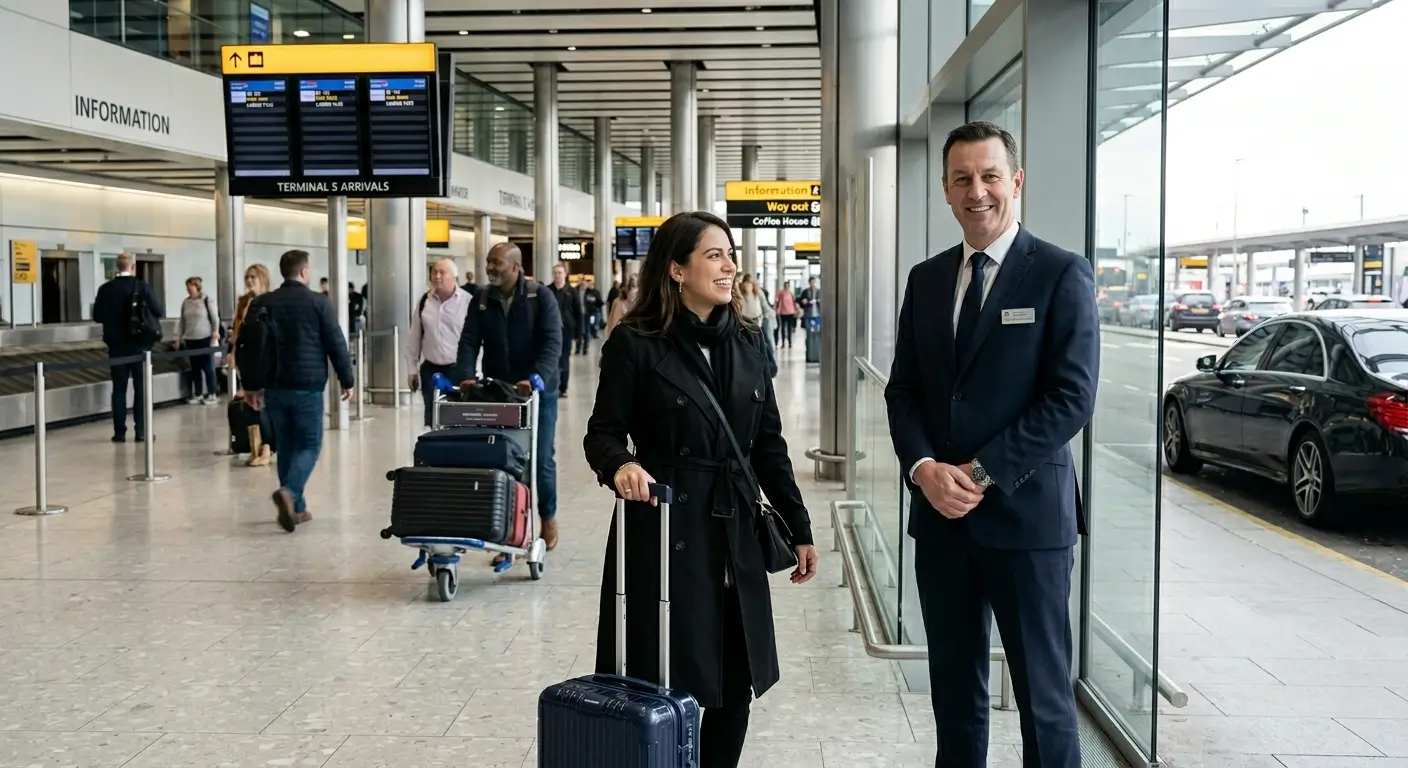
The UK Has Ten Major Airports. Each One Exists for a Different Reason.
Planning a trip to or from the United Kingdom and trying to work out which airport to use can feel unexpectedly complicated. The names blur together. Several share a city. Some require trains within trains. Others serve a single type of traveller so specifically that choosing them without knowing that is a mistake. The good news is that once the logic of the UK airport network becomes clear, the right choice is usually obvious.
Ten airports make up the Umbrella Transfers network, spanning London, the South East, the Midlands, and the North. Between them they handle well over 300 million passenger journeys each year, across commercial scheduled flights, budget leisure routes, long-haul connections, and private aviation. This guide covers all ten: where they are, what they serve, who uses them, how to reach them, and what to expect when travelling through each one.
No single UK airport serves every type of traveller well. Knowing which airport matches your journey type, your airline, and your onward destination is the first decision that shapes everything else.
How to Read the Network
Understanding the Logic Behind the UK Airport Network
The UK airport network divides naturally into four groups. The first is the London commercial six: Heathrow, Gatwick, Stansted, Luton, London City, and Southend. These airports handle the vast majority of scheduled passenger flights, ranging from Heathrow's global long-haul dominance to Southend's emerging short-haul leisure routes. The second group is the London private aviation pair: Biggin Hill and Farnborough, both dedicated exclusively to business jets and private charter, with no commercial airline services. The third is regional: Manchester and Birmingham, which between them serve the North of England and the Midlands with a full range of commercial routes and direct long-haul connections.
Within the London commercial six, a further distinction matters. Heathrow and Gatwick serve a broad mix of airlines and destinations, including long-haul. Stansted and Luton are predominantly budget airline hubs, with strong European coverage but limited intercontinental options. London City is the only airport within the Greater London Authority boundary east of the centre, and its short runway and steep approach make it a niche operation geared specifically to business travel. Southend is the network's newest growth story, positioned as the low-hassle alternative in Essex.
"Choosing the right UK airport is not about finding the biggest or the closest. It is about matching the airport's character to the nature of your journey."Umbrella Transfers Editorial
What follows is a practical profile of each airport, in turn, with the information that actually shapes a transfer decision.
The London Six: Commercial Airports
London's Six Commercial Airports: What Each One Is and Who It Serves
Heathrow Airport (LHR)
Heathrow sits approximately 17 miles west of central London, just inside the M25, and handles more passengers than any other UK airport. In 2025 it processed over 84 million passengers across four terminals, numbered 2, 3, 4, and 5. Terminal 5 is the home of British Airways. Terminal 2, known as the Queen's Terminal, serves the majority of Star Alliance carriers including Lufthansa, Air Canada, and Singapore Airlines. Terminal 3 handles long-haul services from American Airlines, Emirates, and Virgin Atlantic among others. Terminal 4 is currently undergoing a transition in its parking arrangements.
Heathrow is the right airport for travellers flying long-haul, connecting through a major hub, or requiring the broadest possible choice of airlines and destinations. It serves over 200 airports worldwide. The airport's scale is a genuine asset for international connectivity and a genuine complication for navigating between terminals, so allowing time is not optional. Transport into central London is well-developed: the Heathrow Express reaches London Paddington in 15 minutes; the Elizabeth line connects to Paddington, Bond Street, Farringdon, and Liverpool Street in 25 to 40 minutes depending on the destination; the Piccadilly line is slower but less expensive and connects directly to the Underground network. A terminal drop-off charge of £7 per visit applies to vehicles arriving at the terminals.
Gatwick Airport (LGW)
Gatwick sits 30 miles south of central London in West Sussex, making it the furthest of the London airports from the city centre by road. It is the UK's second-busiest airport and operates across two terminals: the North Terminal and the South Terminal, connected by a free shuttle train. Airlines are split between terminals, so confirming which one applies before arrival matters. easyJet, for example, operates from the North Terminal; British Airways uses both. Gatwick serves a wide range of European destinations and a solid selection of long-haul routes to North America, the Caribbean, and East Africa.
The Gatwick Express reaches London Victoria in around 30 minutes with departures every 15 minutes. Southern and Thameslink trains offer a slower but cheaper alternative to London Bridge, St Pancras, and other central stations. By road, the journey to central London takes between 60 and 90 minutes depending on traffic, making a pre-booked transfer considerably more predictable than an ad-hoc taxi.
Stansted Airport (STN)
Stansted is located 40 miles northeast of London in Essex and is the dominant hub for European low-cost carriers, particularly Ryanair. It is a single-terminal airport on a compact site, and the low-cost model that defines it means facilities are functional rather than premium. For travellers connecting to European destinations on Ryanair, easyJet, or Jet2, it is an efficient and often inexpensive option. For those expecting a long-haul network or executive facilities, it is not the right choice.
The Stansted Express is the principal rail link, reaching London Liverpool Street in around 47 to 50 minutes with services every 15 to 30 minutes. Coach services operate around the clock via National Express and Airport Bus Express, reaching Victoria and Liverpool Street in 60 to 90 minutes depending on traffic. By private transfer the airport is accessible to central London via the M11 motorway, typically in 45 to 60 minutes outside peak hours.
Luton Airport (LTN)
Luton sits 34 miles north of central London in Bedfordshire and has long been the base of choice for Wizz Air, easyJet, and Ryanair operating from the north of the capital. It is a compact single-terminal operation with a rail connection that requires one additional step: the Luton DART shuttle covers the four-minute journey between the airport and Luton Airport Parkway station, from which Thameslink trains reach London St Pancras in around 30 to 40 minutes. Coaches are the slower but cheaper alternative, serving Victoria and other central points via National Express and Green Line.
Luton is well suited to budget-conscious travellers heading to European leisure destinations and to travellers staying in north London or the Home Counties. It is less convenient for south or east London, where Gatwick or Stansted represent a shorter overall journey.
London City Airport (LCY)
London City is the only airport genuinely within the city limits, located in the Royal Docks of east London just six miles from the Bank of England. Its runway is short and its approach steep, which limits the aircraft types that can operate there and restricts route length. What it offers in return is unmatched convenience: the DLR connects the airport to Bank and Canary Wharf in 20 minutes without changing trains, and to Stratford for Elizabeth line connections. The airport serves primarily European business destinations and is heavily used by financial services professionals and corporate travellers. A significant share of its passengers are based in Greater London rather than arriving from elsewhere.
For business travellers with meetings in the City, Docklands, or the West End, London City represents a materially shorter door-to-door journey than Heathrow or Gatwick, even for comparable destinations. For families with luggage or groups, the aircraft size and terminal layout make it less practical. London City airport transfers are a natural complement to its DLR connection, particularly for passengers arriving late when public transport frequency drops.
London Southend Airport (SEN)
Southend sits 36 miles east of central London in Essex and is the network's growth story of 2025. Passenger numbers tripled to 720,000 in 2025 following the opening of an easyJet base in April of that year, with 26 routes confirmed for 2026 including Barcelona, Berlin, Jersey, Munich, and Ibiza. It is a compact, single-terminal airport built in 2012, and its operational simplicity has earned it strong punctuality figures: in 2025 it became the most punctual airport in London, with 77.6% of flights departing or arriving within 15 minutes of schedule.
The airport has its own railway station a two-minute walk from the terminal, with Greater Anglia services reaching London Liverpool Street in 52 minutes and Stratford in 43 minutes. For travellers in Essex, east London, or along the Shenfield line, Southend offers a genuinely low-friction departure experience with short queues and straightforward check-in.
Heathrow
Global long-haul hub. Four terminals. 200+ destinations. Best for intercontinental travel and major airline connections.
Gatwick
Strong European and long-haul network. Two terminals, 30 miles south. Best for mid-range and leisure travel.
Stansted
Dominant low-cost hub, 40 miles northeast. Best for European budget routes, particularly Ryanair.
Luton
Budget European carrier base, 34 miles north. Best for north London travellers on Wizz Air and easyJet.
London City
Six miles from the City. DLR access. Best for business travellers in east and central London.
Southend
Fast-growing Essex airport. 26 European routes. Best for east London and Essex travellers seeking low-hassle departures.
Private Aviation
Biggin Hill and Farnborough: London's Private Aviation Airports
Biggin Hill Airport (BQH)
Biggin Hill sits 15 miles southeast of central London in the London Borough of Bromley, approximately 45 to 50 minutes by road from the West End. The airport carries one of the most recognisable names in British aviation history: it served as a key RAF fighter station during the Second World War and today operates exclusively for private and executive aviation, with no commercial scheduled airline services. Two FBOs serve the airport, offering dedicated handling, customs and immigration clearance, private lounges, and direct ramp access for vehicles. For passengers in a hurry, a helicopter transfer service connects Biggin Hill to central London in under ten minutes of flying time.
Biggin Hill registered nearly 50,000 aircraft movements in 2025, making it a genuinely active business aviation hub rather than a quiet airfield. Its single primary runway of 1,806 metres accommodates light to large-cabin private jets. For those arriving in the south of London or heading to Kent, Surrey, or the City, it offers the fastest and most discreet option in the private aviation category.
Farnborough Airport (FAB)
Farnborough is located approximately 37 miles southwest of central London in Hampshire, adjacent to the M3 motorway. It is widely regarded as the leading private aviation facility in the United Kingdom and among the best in Europe. The airport is dedicated entirely to private jet movements, with a terminal designed around a boutique hotel experience rather than an airline terminal: on-site customs, private lounges, direct airside access, and concierge services as standard. For clients requiring discretion, Farnborough's single-operator focus means no commercial passenger queues, no shared security lanes, and no overlap with airline timetables.
A helicopter transfer to central London takes approximately 12 to 15 minutes via Battersea Heliport. By road, Farnborough reaches central London in 45 to 60 minutes under normal conditions, and is especially convenient for the Home Counties, Surrey, and corporate campuses along the M3 and M4 corridors. TAG Aviation provides the primary ground handling at Farnborough, with services including executive lounges and full concierge.
For private aviation passengers, the transfer from aircraft to vehicle is where the experience is either preserved or lost. Both Biggin Hill and Farnborough offer direct ramp access, but the onward road journey still requires a pre-booked, professional transfer to maintain the standard set at the terminal.
Regional Airports
Manchester and Birmingham: The UK's Two Major Regional Airports
Manchester Airport (MAN)
Manchester is the UK's third-busiest airport and the largest outside the London system, processing around 32 million passengers per year. It operates across three terminals, with Terminal 2 serving the majority of airlines and Terminal 3 used exclusively by Ryanair following the closure of Terminal 1 in November 2025. The airline roster is genuinely international: British Airways, Virgin Atlantic, Emirates, Qatar Airways, Singapore Airlines, Etihad, Jet2, Ryanair, and easyJet all operate from Manchester, covering destinations across every inhabited continent. Manchester is one of only two UK airports, alongside Heathrow, to offer sterile transit, making it a viable connection point for long-haul itineraries.
Ground transport from the airport is well-organised. A dedicated rail station beneath Terminal 2 connects to Manchester Piccadilly in 15 to 20 minutes, with onward services across the North of England. The Metrolink tram reaches Manchester city centre in under an hour and extends across the wider Greater Manchester network. National Express coaches connect directly to Birmingham, London, Liverpool, Glasgow, and Edinburgh. By road, the M56 motorway provides access west and south, while the M60 ring road connects to the wider motorway network in all directions.
For travellers based in the North West, Yorkshire, the North East, or Scotland, Manchester Airport represents a materially faster journey than any London alternative. UK-wide airport transfer services that cover Manchester are worth confirming before booking, as not all providers extend their network this far from London.
Birmingham Airport (BHX)
Birmingham Airport sits adjacent to the M42 motorway, eight miles east of Birmingham city centre, and next to the National Exhibition Centre. It served a record 13.65 million passengers in 2025, making it the third-largest UK airport outside London. The airline base includes Ryanair, easyJet, TUI Airways, Jet2, Qatar Airways, and Saudia, covering European leisure destinations, long-haul routes via Doha and Jeddah, and domestic services. Its top routes in 2025 included Dublin, Amsterdam, Dubai, Tenerife, and Paris.
Birmingham International railway station is directly connected to the terminal by a monorail link, with trains reaching Birmingham New Street in 10 minutes and London Euston in just over an hour. The airport is well positioned for the Midlands, central England, Wales, and the western home counties. For travellers visiting Shakespeare's Stratford-upon-Avon, the Cotswolds, or events at the NEC, it is the most logical arrival point. The HS2 project will eventually place Birmingham Airport within approximately 37 minutes of central London by rail, though that timeline remains subject to the ongoing development programme.
| Airport | Code | Distance to Central London | Fastest Rail Link | Rail Time | Best Suited For |
|---|---|---|---|---|---|
| Heathrow | LHR | 17 miles west | Heathrow Express to Paddington | 15 min | Long-haul, all major airlines |
| Gatwick | LGW | 30 miles south | Gatwick Express to Victoria | 30 min | European and long-haul leisure |
| Stansted | STN | 40 miles northeast | Stansted Express to Liverpool St | 47 min | Budget European (Ryanair, easyJet) |
| Luton | LTN | 34 miles north | Thameslink to St Pancras + DART | 35 min | Budget European (Wizz, Ryanair) |
| London City | LCY | 6 miles east | DLR to Bank/Canary Wharf | 20 min | Business, short-haul European |
| Southend | SEN | 36 miles east | Greater Anglia to Liverpool St | 52 min | Essex, east London, budget leisure |
| Biggin Hill | BQH | 15 miles southeast | Private transfer or helicopter | 45 min (road) | Private aviation, south London |
| Farnborough | FAB | 37 miles southwest | Private transfer or helicopter | 50 min (road) | Private aviation, Home Counties |
| Manchester | MAN | 200 miles northwest | Train to Manchester Piccadilly | 20 min | North England, long-haul connections |
| Birmingham | BHX | 110 miles northwest | Train to Birmingham New Street | 10 min | Midlands, NEC, central England |
Fixed-price transfers with meet and greet at every airport in this guide, from Heathrow to Manchester.
Book Your TransferGetting There
Transport Options Across All Ten Airports: What to Expect and What to Weigh Up
Every airport in this network is reachable by multiple modes of transport. The right choice depends on group size, luggage volume, time of day, and where in the UK the journey starts or ends. The following principles apply consistently across all ten airports.
Rail is typically the fastest option for solo travellers or pairs without large luggage, particularly at airports with direct express services: Heathrow, Gatwick, and Stansted all have dedicated trains running frequently to central London termini. At Luton, the additional DART shuttle step adds minor complexity but the overall journey time remains competitive. At London City, the DLR's frequency and proximity to financial district stations makes it the natural choice for business arrivals.
Coach services are the cheapest option from Stansted, Luton, and Gatwick, but journey times are variable and subject to traffic. For travellers with a specific arrival time in mind, a scheduled coach is a poor substitute for a pre-booked transfer. At Manchester and Birmingham, National Express and Flixbus provide connections to cities across the UK, but are unsuitable for time-sensitive journeys without significant buffer.
Private airport transfers provide a fixed-price, door-to-door service with a named driver, no queuing, no connection changes, and no price surprises on arrival. For groups of two or more, the cost per person frequently compares favourably to rail, and the door-to-door convenience eliminates the final mile problem that every rail or coach journey leaves unsolved. Umbrella Transfers covers all ten airports in this guide, with meet and greet included as standard, 30 minutes of free waiting and parking from the scheduled pickup time, and flight monitoring that adjusts collection automatically when flights run early or late.
Choosing the Right Airport
Which Airport Is Right for Your Journey: A Guide by Traveller Type
The right airport depends on who is travelling, from where, and to what destination. These are the most common scenarios and the airport that typically serves each one best.
International visitors flying long-haul
Heathrow is the default. Over 80 airlines operate there including every major intercontinental carrier. If the booking is with British Airways, Virgin Atlantic, or a Star Alliance carrier, the terminal assignment is specific and straightforward. For connections to other UK cities, Heathrow has the broadest onward rail and transfer options.
Business travellers with City or Canary Wharf meetings
London City Airport. The DLR puts Bank station 20 minutes away without a transfer. For early morning or evening flights to European financial centres, the short queue and fast security make the overall door-to-door journey faster than Heathrow, even for some comparable routes.
Leisure travellers on European budget routes
Stansted for Ryanair-heavy itineraries. Luton for Wizz Air and north London departures. Gatwick for easyJet alongside a wider leisure network. Southend for east London and Essex, particularly as easyJet's route map from there expands into 2026.
Families travelling in groups
Gatwick or Heathrow for flexibility and facilities. Both have extensive family amenities, multiple food options, and check-in areas designed to handle luggage. For groups of four or more, a pre-booked airport transfer eliminates the problem of rail connections with heavy bags and reduces the door-to-door time materially.
Private aviation passengers
Farnborough for the highest level of dedicated service and Home Counties convenience. Biggin Hill for south London, Kent, and Surrey access with comparable discretion and shorter transfer times. Both offer direct ramp access and on-site customs, eliminating the commercial terminal experience entirely.
Travellers based in the North or Midlands
Manchester for the North West, Yorkshire, and long-haul connections from outside London. Birmingham for the Midlands, central England, and events at the NEC. Both airports offer extensive European and growing long-haul networks that make a London routing unnecessary for many journeys.
Travellers connecting from London to the UK
For domestic connections, Manchester and Birmingham both have strong links to regional UK destinations. Heathrow maintains domestic services to Edinburgh, Manchester, and Belfast, but these are generally less cost-effective than rail for the same journeys unless timed as part of an international connection.
Late night arrivals and early morning departures
Heathrow, Gatwick, and Stansted all have 24-hour transfer options, but public transport stops well before midnight at most. A pre-booked airport transfer with guaranteed availability is the practical solution, regardless of which airport is involved. Southend and Luton have limited night service; verify rail times before relying on them for early or late connections.
Final Thoughts
The Airport Is the Start. The Transfer Is What Gets You There.
Selecting the right airport for a UK journey is a decision with real consequences. The wrong choice adds an hour to a transfer, requires an extra connection, or places a traveller at an airport whose airline roster does not match their booking. The right choice does the opposite: it removes friction before the journey has begun.
What no airport choice resolves by itself is the question of how to get between the terminal and the final destination. Rail is efficient for solo travellers at airports with express links. For everyone else, particularly groups, families, corporate travellers, and private aviation passengers, a pre-booked transfer with a named driver, fixed pricing, and flight monitoring is the element that connects the airport network to the door.
Umbrella Transfers covers all ten airports in this guide with a consistent standard: meet and greet in arrivals, 30 minutes of complimentary waiting and parking from the scheduled pickup time, automatic flight adjustment when schedules change, and 24/7 real-person support. Economy and executive vehicles accommodate up to eight passengers. Whether the journey starts at Heathrow or ends at Farnborough, the ground transport should be as reliable as the flight.
Check your airline's terminal before travel, not on arrival. Confirm whether rail works door-to-door or only for part of the journey. Book ground transport as early as the flight. For private aviation airports, a pre-booked transfer is not optional; it is the continuation of the service the terminal began.
Fixed-price UK airport transfers
All ten airports. One consistent standard.
Meet and greet included, flight monitoring as standard, fixed pricing confirmed at booking. Covering Heathrow to Manchester and every airport in between.
Book Your Transfer