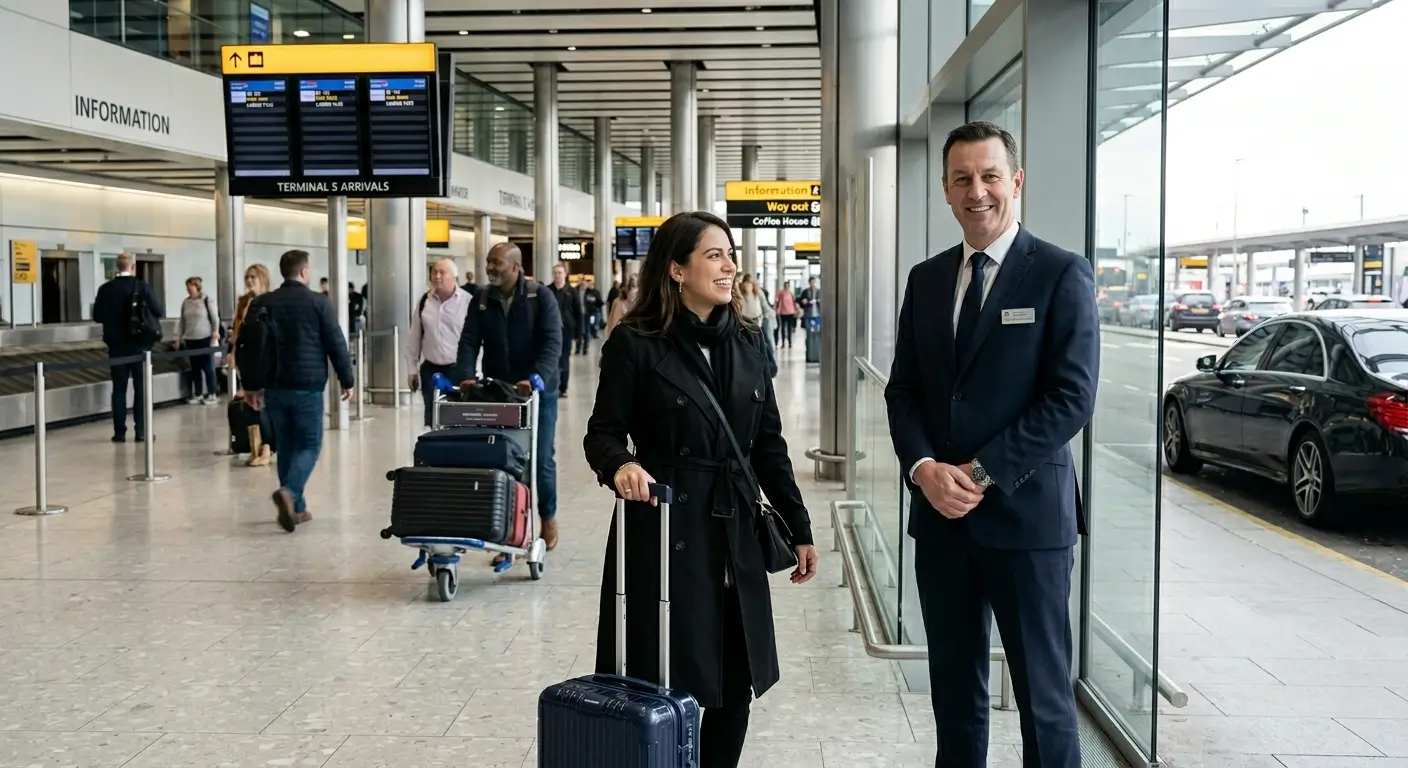
What the UK Arrival Process Actually Looks Like
Most first-time visitors arrive in the UK with a vague sense of what to expect and a fairly specific worry that something will go wrong. The queue at passport control. The baggage carousel that takes longer than expected. The moment of walking through customs without being entirely sure which channel applies to them. These are reasonable concerns. The UK arrival process is not complicated, but it does follow a fixed sequence, and understanding that sequence before landing removes almost all of the anxiety.
The UK receives over 40 million international visitors each year. The arrival infrastructure at the major airports, particularly Heathrow, Gatwick, and Stansted, is designed to move large volumes of passengers efficiently. What catches first-timers off guard is not the complexity but the unfamiliarity. Knowing what comes next, and in what order, is the single most useful thing a new visitor can have before they land.
The UK arrival process follows a consistent sequence: immigration, baggage reclaim, customs. Understanding that order before landing removes almost all first-timer uncertainty.
Before You Travel
Documents and Entry Requirements: What to Sort Before You Board
The most important thing a first-time UK visitor can do is confirm their entry requirements before leaving home. Since 2025, the UK has introduced the Electronic Travel Authorisation (ETA), a digital pre-travel permission that applies to most visa-exempt visitors. This is distinct from a visa. It is not stamped in a passport. It is linked electronically to the passport used to apply. If a visitor's home country requires an ETA, they must hold one before boarding. Airlines check this at check-in, and passengers without one will be denied boarding.
The ETA costs £16 and is valid for two years or until the passport expires, whichever comes first. It permits multiple journeys and stays of up to six months at a time. Applications are made through the official UK ETA app or at GOV.UK, and most decisions arrive within minutes. EU nationals have required an ETA since March 2025. Citizens of the US, Canada, Australia, and many other countries are in the same position. British and Irish citizens do not need one. Anyone who already holds a valid UK visa does not need one either.
Beyond the ETA or visa, every visitor should carry a valid passport. The UK does not impose a six-month validity rule for most nationalities, but individual airlines may. Carrying printed confirmation of accommodation and onward travel is sensible, as Border Force officers may ask for it. Travel insurance is strongly recommended. The NHS does not provide free treatment to international visitors, and medical costs without cover can be significant.
"The ETA is checked before boarding, not at the border. Sorting it in advance is the single action that prevents the most common reason for denied boarding."Umbrella Transfers Editorial
Apply for the ETA through the official UK ETA app or at GOV.UK only. Third-party sites charge inflated fees for the same process. The official cost is £16.
At the Airport
Immigration, Baggage, and Customs: The Three Stages of Arrival
Once the aircraft door opens, the arrival sequence is the same at every UK airport. Understanding these three stages in order is all that is needed to navigate them with confidence.
Stage 1: Immigration
Follow signs for UK Border. Most ETA holders with biometric passports from eligible countries can use e-gates: place the passport face-down, look at the camera, and the gate opens. Those not eligible for e-gates join the All Passports queue, where a Border Force officer checks documents and confirms the purpose and duration of the stay.
Stage 2: Baggage Reclaim
After clearing immigration, follow signs to baggage reclaim. Screens in the hall display which carousel corresponds to which flight. Luggage occasionally takes 20 to 30 minutes to appear after landing at a busy airport. If bags do not arrive, report to the airline's baggage desk before leaving the terminal.
Stage 3: Customs
Every traveller must pass through customs. The Green Channel is for those with nothing to declare beyond the personal allowance. The Red Channel is for those who need to declare goods. Bring only what is permitted. Restricted items include most meat, dairy, and plant products from outside the EU, as well as goods above the duty-free threshold.
The e-gates are available at all major UK airports and can be used by ETA holders aged ten and over with a biometric passport. Those between ten and seventeen must be accompanied by an adult. Processing through e-gates typically takes ten to thirty minutes at most times, with longer waits during peak arrivals periods at Heathrow. Staffed desks take longer but follow the same straightforward process.
The customs Green Channel is for travellers with nothing to declare, not for travellers who are uncertain. If there is any doubt about what is permitted, use the Red Channel and ask.
Getting Around
From the Airport to Your Destination: Transport Options Compared
Choosing how to travel from the airport to accommodation is the decision that affects the first hour of every UK visit most directly. There is no universally correct answer. The right choice depends on how much luggage a traveller is carrying, how familiar they are with public transport, whether they are travelling alone or in a group, and how much certainty they need around timing. The table below outlines the main options from each major London airport.
| Airport | Fastest Rail Option | Journey Time | Approx. Rail Fare | Pre-Booked Transfer | Approx. Transfer Fare |
|---|---|---|---|---|---|
| Heathrow (LHR) | Heathrow Express to Paddington | 15 minutes | From £10 advance / £25 walk-up | ✓ Door-to-door, fixed price | From £50–70 to central London |
| Heathrow (LHR) | Elizabeth Line to Paddington / City | 30 minutes | From £12–13 | ✓ | See above |
| Gatwick (LGW) | Gatwick Express to Victoria | 30 minutes | From £20.50 | ✓ Door-to-door, fixed price | From £60–90 to central London |
| Stansted (STN) | Stansted Express to Liverpool Street | ~50 minutes | From £14 advance | ✓ Door-to-door, fixed price | From £70–90 to central London |
| London City (LCY) | DLR to Bank | ~20 minutes | From £3–4 | ✓ Door-to-door, fixed price | From £25–35 to central London |
| Luton (LTN) | Thameslink + Luton DART to terminal | ~50 minutes total | From £15–20 | ✓ Door-to-door, fixed price | From £65–85 to central London |
A note on airports and distances. Heathrow sits approximately 15 miles west of central London. Gatwick is around 30 miles to the south. Stansted is 40 miles north-east, the furthest of the major London airports despite appearing in the name. London City, by contrast, sits just 5 miles from the financial district, making it the most convenient for east and central destinations. Understanding where each airport sits relative to the city prevents surprises on arrival.
Public transport is efficient and well-connected, but it comes with real considerations for first-time visitors carrying luggage. Step-free access is not universal across the Underground. Changing trains with heavy bags at a busy interchange adds time and effort. A group of two or more travelling together will often find that a pre-booked private transfer is comparable in cost to multiple train tickets, with significantly less complexity.
Pre-Booked Transfers
Why a Pre-Booked Airport Transfer Is the Most Reliable Option for First-Time Visitors
For a traveller arriving in an unfamiliar country for the first time, there is a particular kind of uncertainty that public transport cannot address: not knowing whether the driver is actually there, whether the price agreed online will be the price charged, or whether anyone will help if the flight is delayed and the booking no longer matches the arrival time. A pre-booked private transfer with a reputable provider solves all three of these concerns before they have a chance to become problems.
Umbrella Transfers provides fixed-price, door-to-door airport transfer services across all major UK airports. The price quoted at booking is the price charged. There are no surge fees, no meter running in traffic, and no unexpected additions. Flights are monitored automatically, so if a plane lands early or late, the driver adjusts accordingly. On arrival, the driver meets passengers in the arrivals hall with a name board, so there is no ambiguity about where to go or who to look for. For families with children, passengers with significant luggage, or anyone who simply wants the first hour in a new country to go smoothly, this is the practical choice.
Meet and greet is included as standard. Waiting time is covered for the first 30 minutes after the scheduled landing time, with no charge for airport parking during that period. English-speaking drivers operate across economy and executive vehicle categories, with capacity for groups of up to eight passengers. 24/7 real-person support is available if anything changes before or during the journey. For visitors arriving at Heathrow, Gatwick, or Stansted, coverage extends UK-wide from the point of arrival.
Meet and Greet Included
The driver waits in arrivals with a name board. No searching for a meeting point in an unfamiliar terminal.
Flight Monitoring
Arrival time is tracked automatically. If the flight is delayed or early, the driver adjusts without the passenger needing to make contact.
Fixed Pricing
The price quoted is the price charged. No meters, no surge pricing, no surprises on arrival.
24/7 Real-Person Support
A real person answers if something changes. Not a chatbot. Not an automated system. A team member available around the clock.
Fixed-price UK airport transfers with meet and greet, flight monitoring, and 24/7 support included as standard.
Book Your TransferMoney and Connectivity
Paying for Things in the UK and Staying Connected
The UK is one of the most cashless societies in the world. In 2024, cash accounted for less than 10% of all UK payments for the first time on record. Contactless payment by card or phone is the standard method at almost every shop, restaurant, pub, supermarket, and transport terminal. London buses are entirely cashless. The Underground, DLR, and Elizabeth Line accept contactless bank cards directly, which means a visitor with a contactless Visa or Mastercard from any country can tap in and out of public transport without buying a separate ticket.
The contactless limit on physical cards is £100 per transaction. Payments above this require a PIN. Mobile wallet payments (Apple Pay, Google Pay) operate without a fixed cap. A small amount of cash is still useful for tipping, some smaller independent shops, and rural areas where card infrastructure is thinner. Exchanging currency at airport kiosks typically offers poor rates. ATMs (known as cashpoints in the UK) are widely available and offer better rates. Always decline the option to pay in your home currency when offered, as the exchange rate applied by the terminal is almost always unfavourable.
For mobile connectivity, two options are available on arrival. A physical SIM card can be purchased at airport kiosks from providers including EE, O2, Vodafone, and Three, at a small premium over high-street prices. Airport kiosk prices are typically 10 to 15% higher than equivalent plans bought in a city-centre store. The more convenient approach is to purchase an eSIM in advance from an international provider before departure, then activate it on landing using the airport's free Wi-Fi. All major UK airports provide free Wi-Fi in their terminals. eSIM activation takes a few minutes and provides instant connectivity. Most modern smartphones (iPhone XS and later, Samsung Galaxy S20 and later, Google Pixel 3 and later) support eSIM.
London buses do not accept cash. The Underground accepts contactless bank cards directly. Purchasing an eSIM before departure means arriving already connected, without queuing at an airport kiosk.
Practical Essentials
Plugs, Weather, Emergencies, and the Small Details That Matter
A few practical details are worth knowing before arrival. None of them are complicated, but each one can catch a first-time visitor off guard if they have not been considered in advance.
999 and 112 both connect to the same UK emergency services, free from any phone. NHS 111 handles non-emergency medical advice around the clock. Store both numbers before landing.
Final Thoughts
Arriving Prepared Changes the First Day Entirely
The UK is a straightforward country to arrive in. The airport processes are clearly signposted, the transport connections are frequent, and the language barrier is non-existent for most visitors. What makes the difference between a first day that feels effortless and one that starts with avoidable friction is preparation, specifically the small number of things that need to be arranged before boarding: the ETA confirmed, the travel insurance in place, the adaptor packed, the transport from the airport decided.
None of these decisions are difficult once they are considered in advance. The ETA takes minutes to apply for. The adaptor costs a few pounds. The transport choice between public rail and a pre-booked transfer comes down to how much certainty a traveller wants on their first journey in a new country. For those arriving at one of the major UK airports with luggage and no local knowledge, a pre-booked airport transfer with fixed pricing, meet and greet, and automatic flight monitoring is the option that removes the most variables from an already unfamiliar experience.
The UK rewards visitors who arrive knowing what to expect. Everything after the arrivals hall, from the transport network and the payment systems to the weather and the etiquette, follows a logic that is easy to navigate once it is understood. The guide above is that understanding. The rest is the journey itself.
Apply for the ETA before boarding. Carry travel insurance with medical cover. Pack a Type G adaptor. Choose transport from the airport before landing. Store 999 and 112 in the phone. Arrive knowing the sequence, and the first day takes care of itself.
UK Airport Transfers
Arrive in the UK knowing your driver is already there
Fixed pricing, meet and greet, flight monitoring, and 24/7 support included as standard on every booking.
Book Your Transfer